Skip to content


Pumping water uses a lot of energy, especially from deep boreholes. Grid electricity may be unavailable or unreliable, and diesel generators bring fuel costs, noise and maintenance. Solar pumping uses sunlight, which Kenya has in abundance, to power the pump directly during the day. Water is pumped into a storage tank and used later, so there is no need for batteries in most systems.
Solar borehole pumping is widely used on farms, schools, health centres, homesteads, livestock watering points, community water supplies and in arid and semi-arid regions such as northern Kenya. It is attractive because running costs are low and the fuel is free. The main cost is the upfront investment, and the main risk is a poorly sized system, which either wastes money or fails to deliver the water you need.
This guide explains how to size a system correctly, what the components are and what it costs. Figures are indicative market ranges and should be checked against current quotations.
Start with the Borehole, Not the Pump
A solar pumping system must be designed around the borehole’s actual performance. Before choosing any equipment, you need:
- Borehole depth, diameter and construction details from the completion report.
- Static water level (SWL) and pumping water level (PWL) at the proposed flow rate.
- Safe yield from a proper pumping test. See our article on yield testing and pumping tests. Never size the pump to exceed the safe yield, because that can drain the borehole, expose the screen and damage the pump.
- Water quality, since sand, high salinity, iron and scaling affect pump life and material choice.
- Daily water demand in cubic metres, including future growth.
- Delivery requirements: the height of the storage tank above ground and the distance and pipe size to the tank or irrigation system.
- Available space and shading for the solar array and tank.
If the borehole has not been tested, stop and get a pumping test first, because the pump setting depth and flow rate depend on it.
The Key Sizing Concepts
Daily water requirement (V). The volume you need per day, in cubic metres (m³). For example, 20 m³ per day. Estimate demand from people, livestock, irrigation area and processes. Ask whether storage can bridge cloudy days and how many days of reserve you want.
Total dynamic head (TDH). The total height the pump must lift water, plus friction losses. It is the sum of:
- Pumping water level depth (the depth of the water surface below ground while pumping, not the static level).
- Height from ground to the top of the tank or delivery point.
- Friction losses in the pipes (depend on pipe diameter, length and flow, and are usually a small percentage of the total for properly sized pipes, but can be large for long or narrow pipes).
- Required discharge pressure, for irrigation systems such as drip or sprinklers, expressed as an equivalent head (10 metres of head is roughly 1 bar).
Peak sun hours (PSH). The number of hours per day with sunlight equivalent to 1,000 watts per square metre. Many parts of Kenya receive about 5 to 6 peak sun hours per day on average, though it varies with location and season, with lower values in cloudier, cooler highland areas and higher values in arid regions. Use local irradiation data.
Pumping hours. Solar pumps run only while the sun shines, typically 5 to 8 hours per day depending on system design. Flow rate in cubic metres per hour is therefore the daily volume divided by the effective pumping hours.
Pump and system efficiency. The pump and motor combination converts electrical energy into hydraulic energy with an efficiency that is often in the region of 35 to 60 percent for borehole pumps, depending on size and design. Add losses from cables, controller, temperature and dust on panels.
The Core Formulas
Hydraulic energy needed per day. A convenient formula in practical units is:
Hydraulic energy (kWh per day) ≈ V (m³ per day) × TDH (m) ÷ 367
This comes from the physics of lifting water (density, gravity and unit conversion).
Electrical energy needed per day. Electrical energy (kWh per day) = hydraulic energy ÷ overall pump system efficiency
Solar array size (kWp, kilowatts-peak). Array size ≈ electrical energy per day ÷ (peak sun hours × system derating factor)
A derating factor of about 0.7 to 0.8 accounts for temperature, dust, wiring and controller losses. Always apply a safety margin.
Pump power. The pump’s rated power is selected from the pump curves to deliver the required flow at the required head, and the array must be matched to the pump’s operating voltage and power range, normally in consultation with the pump supplier’s sizing software.
Worked Example
Scenario. A farm needs 20 m³ of water per day from a borehole with a safe yield of 5 m³ per hour. The pumping water level at that rate is 90 m below ground. The storage tank is 15 m above ground, and friction and pressure losses add about 10 m. The area receives about 5.5 peak sun hours per day.
Step 1: Total dynamic head. TDH ≈ 90 + 15 + 10 = 115 m
Step 2: Hydraulic energy. Hydraulic energy ≈ 20 × 115 ÷ 367 ≈ 6.3 kWh per day
Step 3: Electrical energy. If overall pump system efficiency is about 40 percent, electrical energy ≈ 6.3 ÷ 0.4 ≈ 15.7 kWh per day
Step 4: Array size. With 5.5 peak sun hours and a derating factor of 0.75, array size ≈ 15.7 ÷ (5.5 × 0.75) ≈ 3.8 kWp. Adding a margin of 10 to 20 percent gives about 4.2 to 4.6 kWp, which in practice might be a 4.4 to 4.8 kWp array depending on panel size.
Step 5: Flow rate check. Pumping over about 6 effective hours means a flow of roughly 20 ÷ 6 ≈ 3.3 m³ per hour, which is below the safe yield of 5 m³ per hour.
Step 6: Pump selection. Choose a submersible pump whose curve gives about 3 to 4 m³ per hour at about 115 m head, within its efficient operating range, and a compatible controller or variable frequency drive. Set the pump below the lowest expected pumping water level with a safety margin (and above the screen and the sump to avoid sand intake).
Step 7: Tank sizing. A tank of about 20 to 30 m³ gives one to one and a half days of storage, which covers the night and cloudy days. For critical supplies, increase storage. The tank volume is cheaper than batteries as a way of storing energy for water supply.
This example illustrates the logic. Real designs should be verified with supplier sizing tools and checked against actual pump curves.
Main Components of a Solar Pumping System
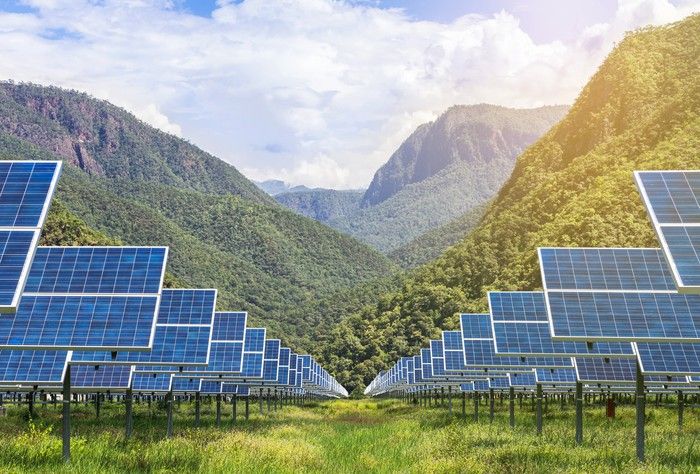
1. Solar PV array. Panels mounted on a fixed frame facing the equator (in Kenya, near the equator, panels are typically tilted at a modest angle and oriented roughly north or south, depending on location, with a small tilt for self-cleaning by rain). Quality, certified panels and a robust mounting structure matter. Anti-theft measures are important in many areas.
2. Pump controller or inverter. Converts the DC from panels to the form needed by the pump motor and tracks the maximum power point. Controllers include dry-run protection, low-water cut-off inputs, tank-full switches and often remote monitoring options.
3. Pump and motor.
- Submersible pump: the most common for boreholes. Can be a DC or AC motor type, with modern systems frequently using AC induction or permanent-magnet motors driven by a solar-specific VFD.
- Surface pumps: for shallow wells and surface water.
- Positive displacement (helical rotor) pumps: efficient at low flow and high head, sometimes used in deeper boreholes with low yield.
- Centrifugal pumps: suit higher flow and moderate head.
4. Rising main, cables and fittings. Pipes (often uPVC or HDPE, or galvanised steel for deeper settings), a non-return valve, a pressure gauge, a flow meter or water meter (which is also required for abstraction permits), a sanitary seal and a safety rope for retrieving the pump.
5. Sensors and protection. A water level probe or electrode in the borehole to stop the pump when water is low, a float switch in the tank to stop the pump when the tank is full, surge and lightning protection, earthing, and a lockable enclosure.
6. Storage tank and stand. Elevated tank (plastic, steel or masonry) for gravity distribution. Tank height determines pressure and the delivery head the pump must overcome.
7. Distribution system. Pipes, taps, troughs, irrigation lines, filters and fittings.
8. Optional batteries and hybrid backup. Batteries add cost and maintenance and are rarely needed, except where pumping at night or electrical loads beyond pumping are required. Hybrid systems with grid or generator backup provide flexibility.
9. Remote monitoring. Some systems offer GSM or app-based monitoring of flow, energy and faults.
Indicative Costs in Kenya
Prices change with exchange rates, brands, capacity and location, so use the following as rough, indicative ranges and obtain written quotations from reputable suppliers.
- Complete solar pumping package (pump, controller, array, basic installation) for a typical deeper borehole: often quoted in the range of several hundred thousand shillings up to well over one million shillings. Published contractor price lists have shown full borehole equipping with pump, solar and tank infrastructure from around KSh 800,000 to KSh 1.5 million or more, depending on depth, flow and what is included.
- Smaller systems for shallow wells or low-flow domestic use: cost less, sometimes in the range of tens of thousands to a few hundred thousand shillings.
- Large systems for irrigation or institutions (for example 10 kWp and above): cost substantially more, scaling with array size and pump power.
- Storage tank and stand: from tens of thousands of shillings for small tanks to several hundred thousand or more for large elevated tanks and stands.
- Cables, pipes and fittings: depend strongly on depth, since the rising main and cable run the full length down the borehole.
- Installation, transport and commissioning: a notable share, particularly in remote areas.
- Fencing, anti-theft measures and protection: an essential extra in many sites.
- Water meter and abstraction permit requirements: see our permit articles.
Cost drivers. Depth and head (they drive pump size and array size), flow rate, array size, equipment quality and brand, storage volume, distance to the site, installation complexity and the supplier’s margin and warranty terms.
Cost per cubic metre. Solar pumping has high capital cost but very low running cost, so over the system’s life the cost per cubic metre of water is often lower than diesel pumping, particularly for sites far from the grid. A simple payback comparison against diesel should include fuel, fuel transport, generator maintenance and downtime.
Solar vs Grid vs Diesel for Pumping
- Solar: low operating cost, simple, quiet and reliable when well designed, but it depends on daylight and needs storage for evening use.
- Grid: good where reliable supply and acceptable tariffs exist, with no capital for generation, but grid outages can interrupt pumping, and connection costs may be high for remote sites.
- Diesel generator: lower initial cost but high fuel and maintenance costs, noise, fuel logistics and emissions.
- Hybrid: solar plus grid or generator gives resilience for critical operations.
For many boreholes, solar is the best long-term option, especially when combined with efficient storage and irrigation systems.
Design Tips and Best Practices
- Match the pump to the tested yield and the pumping level, not the static level, and avoid over-pumping.
- Do not oversize the pump “to be safe.” An oversized pump can pump the borehole dry or cause damage, and wastes money.
- Prefer water storage over batteries where possible.
- Include a low-water cut-off and tank-full switch to protect equipment and avoid wasting water.
- Position the array on stable, shade-free ground, facing the correct direction, with anti-theft measures.
- Clean the panels regularly, since dust can reduce output significantly, especially in dry areas.
- Use correct cable sizing to reduce voltage losses, especially for deep boreholes.
- Install a water meter and keep records for permit compliance.
- Protect the system against lightning and surges with proper earthing and protection devices.
- Plan maintenance: pumps wear, sensors fail and panels need cleaning. Agree on a service schedule, spare parts and who is responsible, especially in community systems.
- Check water quality. Sand, scaling and high salinity shorten pump life and may require special materials or filtration.
- Use reputable suppliers with warranties and local service support.
Common Mistakes
- Sizing the system from the static water level instead of the pumping water level.
- Skipping the pumping test and guessing the yield.
- Ignoring friction losses and delivery pressure requirements for irrigation.
- Buying a cheap, uncertified pump that fails early.
- Poor mounting and lack of anti-theft measures.
- No tank-full or low-water cut-off.
- Not allowing for seasonal changes in groundwater level.
- Overlooking permits and meter requirements.
- Placing the pump too close to the screen or the borehole bottom, causing sand intake.
- No maintenance plan for community or institutional systems.
Integrating Solar Pumping with Water Resource Management
Solar pumps can pump as long as the sun shines, which can lead to over-abstraction if not controlled. Use meters, tank-full cut-offs and monitoring to keep abstraction within the safe yield and permit conditions. In shared aquifers, uncoordinated solar pumping can lower water levels over time, so combine pumping with water level monitoring and good aquifer management. See our articles on why boreholes dry up and on abstraction permits.
Frequently Asked Questions
Do I need batteries for solar pumping? Usually not. Storing water in a tank is cheaper and simpler than storing electricity.
How long do solar pumping systems last? Panels often have warranties of 20 years or more, while pumps and controllers typically need service or replacement earlier, depending on water quality and duty. Good maintenance extends life.
Can solar pumps run at night? Not without batteries or a hybrid power source. The tank provides night supply.
What size solar pump do I need? It depends on daily demand, total dynamic head, the borehole’s safe yield and local sunshine. Use the method above and verify with the pump supplier.
Can I upgrade a diesel system to solar? Often yes, by installing a solar-compatible pump or a hybrid controller, but sizing and compatibility must be checked.
Does cloud cover stop the pump? Output drops with cloud, so the pump delivers less water, and may stop at very low light. Adequate storage covers short-term variations.
Conclusion
A well-designed solar borehole pumping system turns Kenya’s sunshine into reliable water. Success depends on starting with the borehole’s tested yield and pumping level, calculating head, daily demand and array size correctly, choosing quality components, adding sensible storage and protection, and planning maintenance. Capital costs are significant, but low running costs make solar pumping one of the most economical long-term options for farms, institutions and communities.
For hydrogeological surveys, pumping test interpretation and advice on borehole yield and sustainable abstraction to support your pumping design, contact Reg. Geol. Mbugua Githae (MGSK) through consult.innercoregeoconsultants.co.ke.