Skip to content


Water is the foundation of farming. Whether you keep a few dairy cows, grow vegetables for the market or run a commercial horticulture enterprise, you need a water source that is reliable, affordable and safe. In Kenya, two options dominate farm water planning: rainwater harvesting (RWH), which collects and stores rain from roofs, land surfaces or catchments, and boreholes, which tap groundwater.
Neither is universally better. The right choice depends on your rainfall, geology, water demand, budget, crops or livestock, regulatory obligations and risk tolerance. Often the best solution is a combination. This article compares the two options objectively and gives you a framework for deciding.
How Each Option Works
Rainwater harvesting captures rainfall and stores it for later use. Common systems for farms include:
- Roof catchment with tanks: gutters from farm buildings, houses and greenhouses lead to plastic, masonry or ferrocement tanks.
- Surface catchments and water pans: excavated ponds or earth dams that collect runoff, often lined to reduce seepage.
- Ground catchments and rock catchments: prepared surfaces that channel water to storage.
- Greenhouse roof harvesting: very effective because of large roof area.
- In-field and soil moisture harvesting: terraces, zai pits, contour bunds and mulching that keep rain in the soil, which is a form of rainwater management complementing storage.
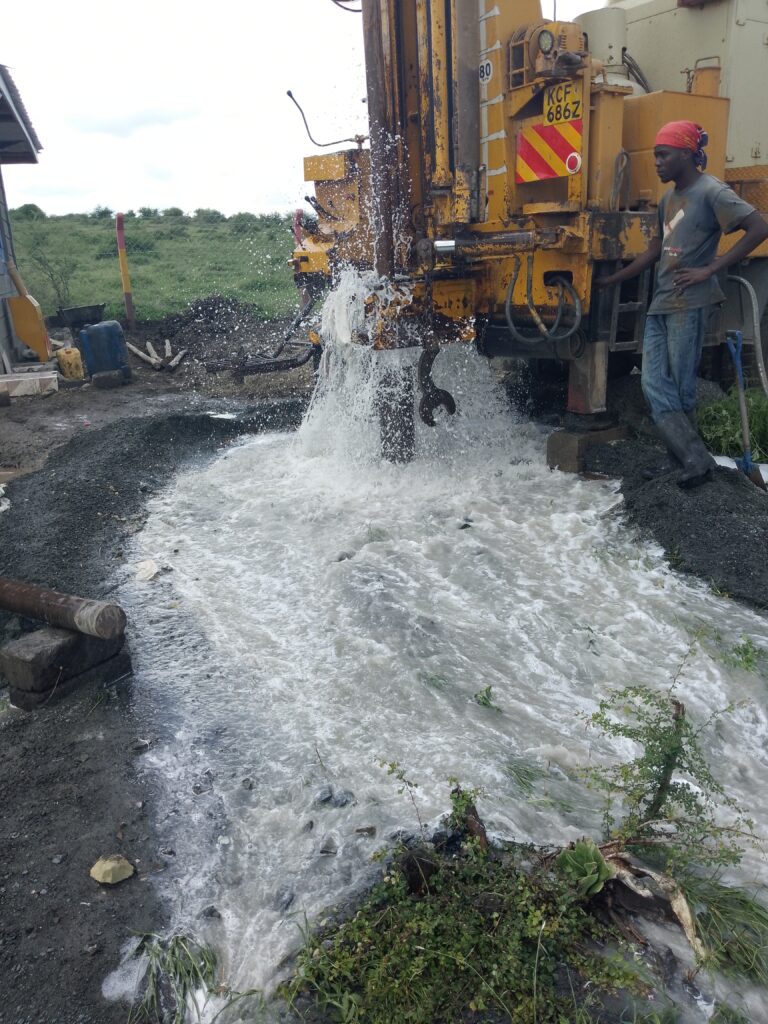
A borehole is a drilled well, typically tens to hundreds of metres deep, that taps an aquifer. Water is lifted by a pump powered by electricity, a generator or solar panels, and is stored in tanks for distribution.
Water Yield: How Much Can You Expect?
Rainwater. The volume you can harvest is straightforward to estimate:
Harvestable volume (litres) ≈ roof or catchment area (m²) × rainfall (mm) × runoff coefficient
For roofs, the runoff coefficient is typically about 0.8 to 0.9 after allowing for losses. For example, a 500 m² greenhouse roof in an area receiving 900 mm of rain per year can theoretically supply 500 × 900 × 0.85 = about 382,500 litres, or around 380 m³ per year. That is roughly 1 m³ per day on average, but the rain falls seasonally, so you need storage to carry water through dry months. If your crop needs 5 m³ per day, a roof alone cannot meet it year-round.
Borehole. Yield depends on the aquifer. Boreholes in Kenya range from marginal (under 1 m³/h) to very productive (over 20 m³/h). A borehole sustainably yielding 3 m³/h and pumped 8 hours a day provides about 24 m³ per day, many times the output of a modest roof catchment, and available through the dry season, if the aquifer is sustainable. A pumping test determines the safe yield.
Reliability and Seasonality
Rainwater harvesting depends on rainfall. In bimodal rainfall regions (long and short rains), tanks refill twice a year, but prolonged droughts can leave tanks empty. Reliability improves with larger storage, but storage costs money. In arid and semi-arid areas, rainfall is too low and erratic for rainwater alone to support irrigation, although it is valuable for domestic and livestock use.
Boreholes provide water year-round if the aquifer is productive and sustainable, making them more drought-resilient in many settings. However, boreholes can fail or decline from over-pumping, interference, clogging or pump faults, and deep groundwater in some arid areas is poorly recharged. Water levels can also decline during extended droughts.
For farms that need water in the dry season, when rainwater is exhausted, boreholes often provide the reliability that tanks cannot, while rainwater provides cheap supplementary supply in the rains.
Cost Comparison
Rainwater harvesting costs include gutters, downpipes, first-flush devices and filters, tanks or pans, and liners. A plastic tank of 10,000 litres may cost tens of thousands of shillings, with larger tanks costing proportionally more, so storage of hundreds of cubic metres becomes expensive. Water pans and dams cost less per cubic metre stored when soil conditions allow, but need excavation, lining and fencing and lose water through evaporation and seepage. Running costs are low because gravity often drives distribution.
Borehole costs are higher upfront. As our cost guide explains, a borehole project including survey, permits, drilling and test pumping often falls between about KSh 600,000 and KSh 2.5 million, and equipping with pump, solar and storage can add KSh 800,000 to KSh 1.5 million or more. Running costs depend on pumping energy, maintenance and permit fees.
Cost per cubic metre. A rule of thumb is that rainwater storage becomes uneconomic for large volumes beyond what the rainfall can fill, whereas a borehole’s high initial cost is spread over a large volume of water, giving lower cost per cubic metre when demand is high. For small demand, such as household and a few animals, rainwater is often cheaper. For commercial irrigation, boreholes or large reservoirs are usually more economical.
A simple, illustrative comparison (numbers are indicative only):
| Item | Rainwater harvesting (greenhouse roof plus tanks) | Borehole (150 m, solar) |
|---|---|---|
| Typical capital cost | KSh 200,000 to 1,500,000 depending on tank volume | KSh 2,000,000 to 4,000,000 |
| Annual water supply | Limited by roof area and rainfall | Limited by safe yield and permit |
| Dry-season reliability | Depends on storage | Generally good if aquifer is sustainable |
| Running cost | Very low | Pump energy, maintenance, permit fees |
Water Quality
Rainwater is naturally soft and low in dissolved minerals, and it is free of fluoride and salts, which is a major advantage in the Rift Valley and arid areas where groundwater can be fluoride-rich or saline. Quality problems arise from the catchment and storage: bird droppings, dust, leaves, roof materials (avoid roofs with lead paint or asbestos) and contaminated tanks. Use first-flush diverters, screens, covered tanks and regular cleaning, and treat water (filtration and chlorination) for drinking.
Borehole water quality depends on the aquifer. It is often naturally filtered and protected from surface contamination, and may be excellent in many areas. But groundwater can contain fluoride, high salinity, hardness, iron or nitrate. Our water quality testing and fluoride articles explain these risks. Always test borehole water before use.
For crops, salinity and sodium are important. Highly saline borehole water can damage soil and reduce yields, while rainwater is generally excellent for irrigation. Livestock can be sensitive to fluoride, sulphate and salinity in groundwater.
Regulation and Permits
Boreholes are regulated. You need hydrogeological documentation, authorisation from the Water Resources Authority before drilling, possibly NEMA and county approvals, an abstraction permit and a water meter. Permit processing can take months. See our permit articles.
Rainwater harvesting from roofs on your own property generally faces lighter regulatory requirements, although larger structures such as dams and pans, and abstraction from rivers and streams, can require authorisation and environmental assessment. Always check the rules for your project scale with the Water Resources Authority and the county.
Environmental and Sustainability Considerations
Rainwater harvesting reduces pressure on groundwater and rivers, reduces runoff and erosion from roofs and compacted surfaces and can support recharge when structures are designed for infiltration. It uses a renewable resource, though over-capture upstream can affect downstream flows in some contexts.
Boreholes draw on groundwater, which is renewable only to the extent that it is recharged. Over-pumping can lower water tables and affect neighbours, and in some arid aquifers recharge is minimal. Sustainable boreholes rely on proper siting, safe yield pumping, monitoring and recharge protection. Solar-powered pumping reduces carbon emissions compared with diesel generators.
Matching the Option to Your Farm
Small-scale mixed farms and homesteads (a few animals, kitchen garden). Rainwater harvesting from the roof with a few tanks may meet most needs in medium to high rainfall areas. Add a shallow well or neighbouring supply for the dry season if necessary.
Dairy farms. Dairy cattle drink a lot of water (often 50 to 100 litres per cow per day, depending on lactation and climate) and need water for cleaning. A moderate herd needs several cubic metres daily, which roof catchment can partially supply but usually needs a reliable second source such as a borehole in dry months.
Horticulture, flowers and greenhouse farming. Greenhouses provide large roof areas for rainwater harvesting, which gives high-quality irrigation water. But year-round production typically needs more water than rainfall can supply, so many commercial growers combine rainwater collected in large reservoirs with boreholes or river abstraction. See our article on borehole costs for commercial horticulture.
Field crop irrigation. Large irrigation volumes usually exceed what roof catchments can supply. Boreholes, rivers, dams or water pans are common options, and water-efficient methods such as drip irrigation matter.
Arid and semi-arid areas. Rainfall is low and erratic. Boreholes or sand dams may be essential for reliable supply, though water quality must be checked, and rainwater harvesting remains important for drinking water and for storage from occasional heavy rains.
Rift Valley areas with high fluoride in groundwater. Rainwater harvesting for drinking and cooking is an excellent way to avoid fluoride, while boreholes can supply other uses, or treated water can be used with monitoring.
A Decision Framework
Work through these questions:
- How much water do I need, and when? Calculate daily and seasonal demand for people, livestock and crops.
- How much can rainwater supply? Calculate harvestable volume and the storage needed to bridge dry periods.
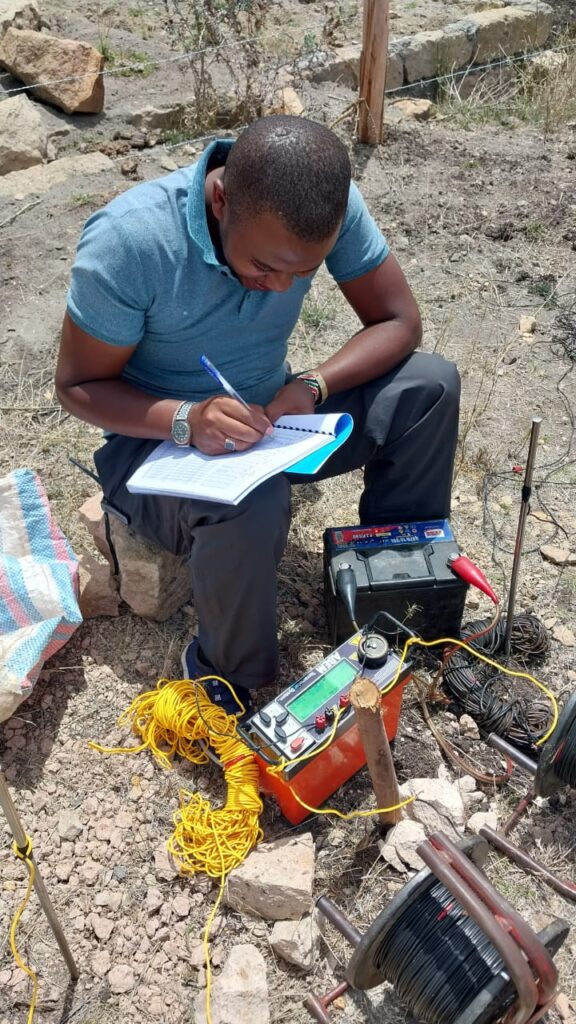
- What is the groundwater potential at my site? Get a hydrogeological opinion. In areas with poor or saline groundwater, the borehole option may be unattractive.
- What is my budget and time horizon? Boreholes require higher capital and time for permits. Rainwater can be implemented incrementally.
- What is the water quality risk? Consider fluoride, salinity and contamination on both sides.
- What is the regulatory position? Account for permits and approvals.
- What is my risk tolerance? Do you need guaranteed dry-season supply, or can you accept seasonal shortfalls?
- Can I combine options? A hybrid system often gives the best resilience.
The Power of Combining Both
Many successful farms use an integrated approach:
- Harvest rainwater from all roofs, greenhouses and suitable surfaces, storing it in tanks and lined reservoirs, and using it first.
- Use a borehole as a backup and for dry-season demand, pumping only as needed to stay within safe yield and permit limits.
- Improve efficiency through drip irrigation, mulching and scheduling.
- Protect and recharge groundwater through soil conservation and infiltration structures.
- Monitor both systems and adjust over time.
This approach reduces reliance on any one source, lowers cost, extends borehole life and supports sustainability.
Common Mistakes to Avoid
- Sizing rainwater storage without calculating actual rainfall and demand.
- Drilling a borehole without a hydrogeological survey and permits.
- Ignoring water quality testing for either source.
- Using untreated rainwater from dirty roofs for drinking.
- Pumping the borehole beyond its safe yield.
- Neglecting maintenance of gutters, filters, tanks, pumps and meters.
- Failing to plan for droughts.
Frequently Asked Questions
Can I run a commercial farm on rainwater alone? In high-rainfall areas with large catchments and storage, partially. Most commercial operations need an additional source for reliability.
Is a borehole always more expensive? Upfront, yes. Per cubic metre over its life, it can be cheaper for high demand.
Is rainwater safe to drink? It can be, with clean catchments, first-flush diversion, filtration and disinfection. Test periodically.
Do I need a permit to harvest rainwater from my roof? Roof harvesting is generally simple, but large dams, pans or river abstraction have requirements. Confirm with the relevant authorities.
What about water pans? They are cost-effective for storing large volumes of runoff but lose water to evaporation and seepage and need careful siting, lining and safety measures. A geotechnical assessment of soil and foundation conditions is useful.
Conclusion
Rainwater harvesting and boreholes each have strengths. Rainwater is cheap, clean and sustainable but limited by rainfall and storage. Boreholes provide reliable, high-volume supply but cost more, need permits and require careful management. For most Kenyan farms, a combination of the two, guided by calculations, a hydrogeological survey and water quality testing, offers the most resilient and economical water supply.
To assess groundwater potential for your farm and plan a sustainable water strategy, contact Reg. Geol. Mbugua Githae (MGSK) through consult.innercoregeoconsultants.co.ke.