Skip to content

Groundwater development projects fail for a lot of reasons, but one of the most preventable is choosing the wrong consultant to run the survey in the first place. Unlike many technical services, the quality gap between a rigorous hydrogeological consultancy and a superficial one often isn’t visible until months later — when a borehole that was confidently sited turns out to be dry, or low-yielding, or contaminated. Knowing what to look for before committing to a consultant is one of the highest-leverage decisions in the entire project.
Why This Choice Matters More Than It Might Seem
A hydrogeological survey report can look professional and thorough regardless of whether the underlying work was actually rigorous. Confident language, clean formatting, and technical terminology don’t guarantee that adequate geophysical coverage was performed, that a pumping test ran long enough to produce a reliable sustainable yield estimate, or that water quality was screened for regionally relevant contaminants. Because clients commissioning these surveys often aren’t hydrogeologists themselves, evaluating consultant quality requires asking the right structural questions rather than simply reviewing a polished final report.
Credentials and Track Record
Professional registration and qualifications. Ask whether the lead hydrogeologist holds relevant professional geological or engineering registration recognized in the project’s jurisdiction, and what formal training and experience specifically in hydrogeology (as opposed to general geology) they bring to the project.
Relevant regional experience. A consultant with a strong track record in a different hydrogeological setting — say, sedimentary basin aquifers — may not transfer that expertise seamlessly to fractured basement terrain, where groundwater occurrence is controlled by an entirely different set of structural factors. Ask specifically about experience in the project’s actual geological setting, not just general years in the field.
References and past project outcomes. Request references from previous clients, and where possible, ask about actual borehole success rates from the consultant’s past siting recommendations — a consultant confident in their methodology should be comfortable sharing this kind of outcome data.
Methodology Transparency
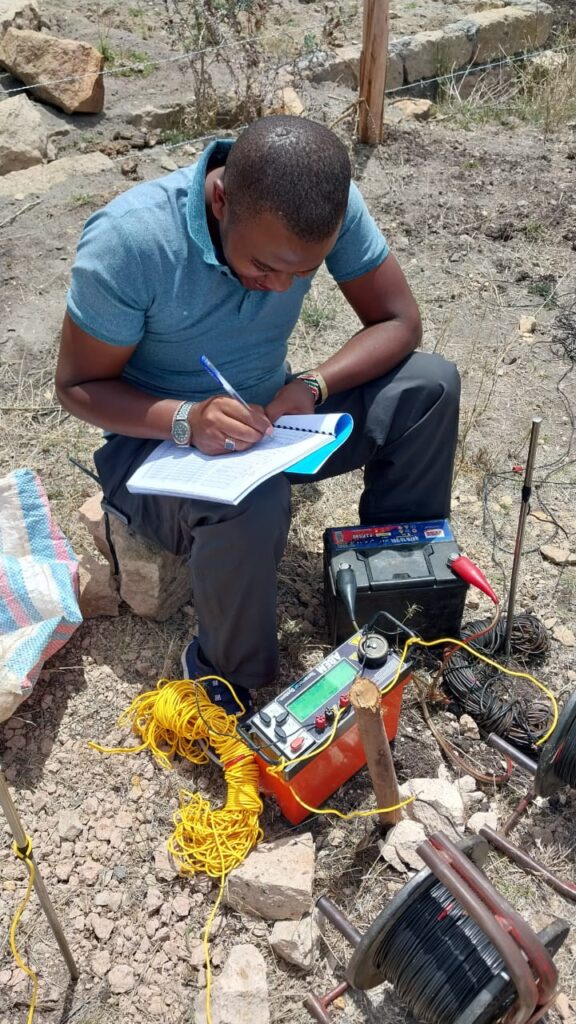
A consultant proposing a survey should be able to clearly explain, before the project begins, what specific stages their methodology includes — desk study scope, field reconnaissance approach, geophysical methods and coverage, pumping test duration and design, and water quality analysis parameters. Vague answers, or a proposal that jumps straight from a brief site visit to a drilling recommendation without describing intervening geophysical or hydrogeological analysis, is a meaningful red flag.
Specific questions worth asking directly:
- What geophysical method will be used, and how many survey lines or soundings are planned for this specific site?
- What duration is planned for the pumping test, and does it meet recognized standards for reliable sustainable yield estimation?
- What water quality parameters will be tested, and are they matched to known regional concerns (fluoride, salinity, or other locally relevant issues)?
- Will raw field data — geophysical profiles, pumping test water level records — be provided alongside the final interpreted report, allowing independent review?
Reading the Proposal Itself
A well-structured proposal should include a clearly itemized scope of work, matching the methodology discussed above, alongside specific, named deliverables — a written report, geophysical survey data and interpretation, pumping test data and analysis, water quality lab results — rather than a vague promise of “hydrogeological services.” Timeline estimates should be realistic given the project’s scope and site conditions, and pricing should be transparent enough that the client can understand what’s driving cost, rather than presented as an unexplained lump sum.
Red Flags Worth Taking Seriously
Guaranteed water promises. No responsible hydrogeologist can guarantee a productive borehole before drilling — geological uncertainty is inherent to groundwater exploration, and a consultant promising certainty is either inexperienced or being deliberately misleading to win the contract.
Skipping geophysics on the basis of “local knowledge” alone. While local knowledge is a valuable input, particularly regarding existing wells and historical water availability, it shouldn’t substitute entirely for direct subsurface investigation in a properly scoped survey.
Unusually short pumping tests. A consultant proposing a test lasting only an hour or two, rather than the 24-72 hours typically needed for a reliable constant-rate test, is likely cutting a corner that will directly compromise the sustainable yield estimate the client is paying for.
Reluctance to share raw data. A consultant unwilling to provide underlying geophysical profiles or pumping test records alongside the interpreted report — insisting the client simply trust the final conclusions — makes independent verification impossible and should raise questions about confidence in the underlying work.
Balancing Cost Against Rigor
It’s reasonable for cost to factor into consultant selection, particularly for budget-constrained community or smaller-scale projects — but cost comparisons should be made between proposals offering genuinely comparable scope, not between a rigorous, fully-scoped survey and a stripped-down alternative that happens to look cheaper on paper. A materially cheaper proposal that skips geophysics or shortens the pumping test isn’t a bargain; it’s a different, considerably riskier project being compared against the wrong benchmark.
The Bottom Line
Choosing a hydrogeological consultant is fundamentally a due diligence exercise, and the questions worth asking are ones any competent, honest consultancy should welcome rather than deflect. Credentials, methodology transparency, and a track record willing to withstand scrutiny are the practical signals that separate a survey genuinely designed to reduce risk from one that merely satisfies a procedural checkbox — and given how much rides on the drilling decision that follows, that distinction is worth taking seriously before any contract is signed.