Skip to content


Many people still search for “WARMA borehole permit.” WARMA stands for the Water Resources Management Authority, the regulator created under the Water Act 2002. When Kenya enacted the Water Act 2016, the institution was restructured and is now called the Water Resources Authority (WRA). The functions remain similar: WRA regulates the use and protection of water resources, including groundwater, and issues authorisations for drilling and abstracting water.
So when someone says “WARMA permit” today, they usually mean the permit or authorisation you obtain from WRA before drilling a borehole. This guide uses the current name, WRA, while keeping the older term for readers searching with it.
Why You Need a Permit
Groundwater is a public resource vested in the state. The law requires anyone who wants to drill a borehole and abstract groundwater to obtain authorisation. The purposes are to:
- Protect aquifers from over-abstraction and contamination.
- Prevent conflicts between neighbouring water users.
- Maintain records of groundwater use for planning.
- Ensure that boreholes are constructed to proper standards.
Drilling without authorisation is an offence and can lead to penalties, enforcement action and difficulty regularising the borehole later.
Two Permits to Understand: Drilling Authorisation and Abstraction Permit
People often confuse these. In practice there are two stages:
- Drilling authorisation (borehole drilling permit): granted before drilling so you may construct the borehole.
- Water use or abstraction permit: obtained after the borehole is drilled and tested so you may legally pump and use the water. Our companion article on the groundwater abstraction permit explains this stage.
This article focuses on stage one but outlines how it connects to stage two.
Step 1: Confirm You Have the Right to Use the Land
You must demonstrate lawful interest in the land where the borehole will be drilled. This is usually a title deed, lease, allotment letter or, for community or institutional projects, proof of authority to use the land. If the land is not yours, you may need written consent from the owner. Keep copies of these documents ready for the application.
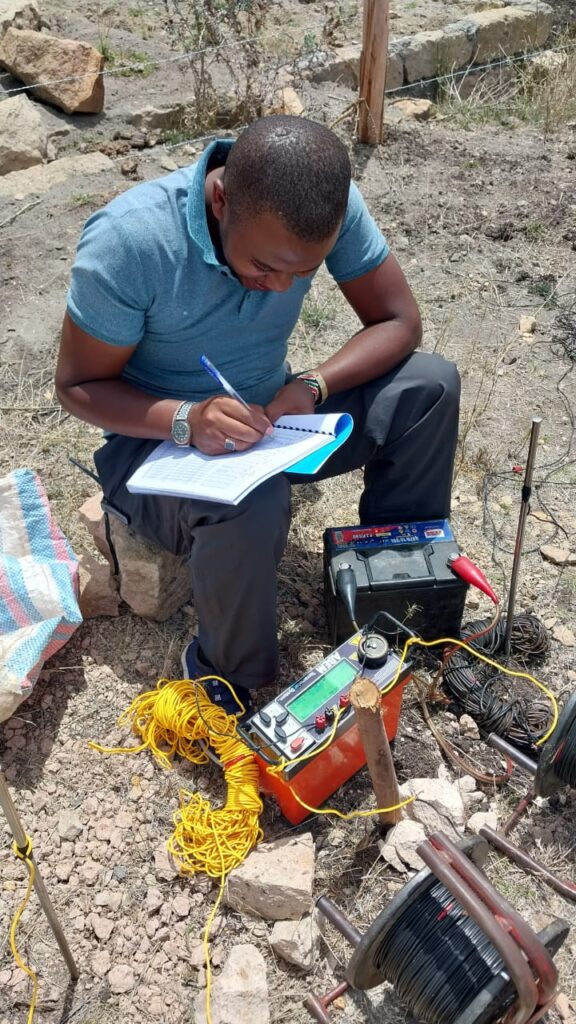
Step 2: Commission a Hydrogeological Survey and Report
A hydrogeological survey is the technical foundation of the application. A qualified hydrogeologist studies the site and prepares a report that includes the proposed drilling location with coordinates, the expected aquifer and depth, anticipated yield, the proposed borehole design and an assessment of potential impacts on neighbouring sources. WRA relies on this report to decide whether the borehole is appropriate for the location. See our articles on the survey cost and why a survey is needed.
Step 3: Obtain County and Local Clearances Where Required
In several counties, including Nairobi, Kiambu and Machakos, a “no objection” letter or planning approval from the county water department or the local water service provider may be required before WRA processes your application. This helps ensure that the borehole does not conflict with planned water supply infrastructure. Requirements vary by county, so check with your county water office.
Step 4: Environmental Screening or Impact Assessment (NEMA)
Under the Environmental Management and Co-ordination Act (EMCA) and the Environmental (Impact Assessment and Audit) Regulations, projects can be subject to screening or an Environmental Impact Assessment. For small domestic boreholes, a simplified process or exemption may apply, while commercial, industrial or large-volume abstraction commonly requires an EIA study and a NEMA licence. An EIA typically includes site description, baseline conditions, public participation, impact assessment and a management plan. Because requirements depend on scale and location, ask your consultant or NEMA which category applies to you.
Step 5: Prepare and Submit the WRA Application
The application is typically submitted through WRA’s regional or sub-regional offices or its online system where available. Typical contents include:
- Completed application form for the borehole drilling authorisation.
- Hydrogeological report with coordinates and site map.
- Proof of land ownership or authority to use the land.
- Identification documents and tax registration of the applicant or company.
- County clearance or no-objection letter, if applicable.
- NEMA approval or screening decision, if applicable.
- Application fee payment.
- Details of the intended use and expected volume of water.
- Details of the licensed drilling contractor.
Always get the current checklist from WRA, because forms and requirements are updated.
Step 6: Assessment and Possible Site Inspection
WRA officers review the application and may conduct a site inspection to verify the location, check proximity to other boreholes, rivers or protected areas, and confirm that the hydrogeological report is consistent with local conditions. They may request clarifications or additional information. Responding promptly keeps the process moving.
Step 7: Receive Drilling Authorisation
If the application is approved, WRA issues the authorisation, which may include conditions, such as maximum depth, casing requirements, sanitary seal requirements, submission of drilling logs or monitoring obligations. Read the conditions carefully and ensure your contractor follows them.
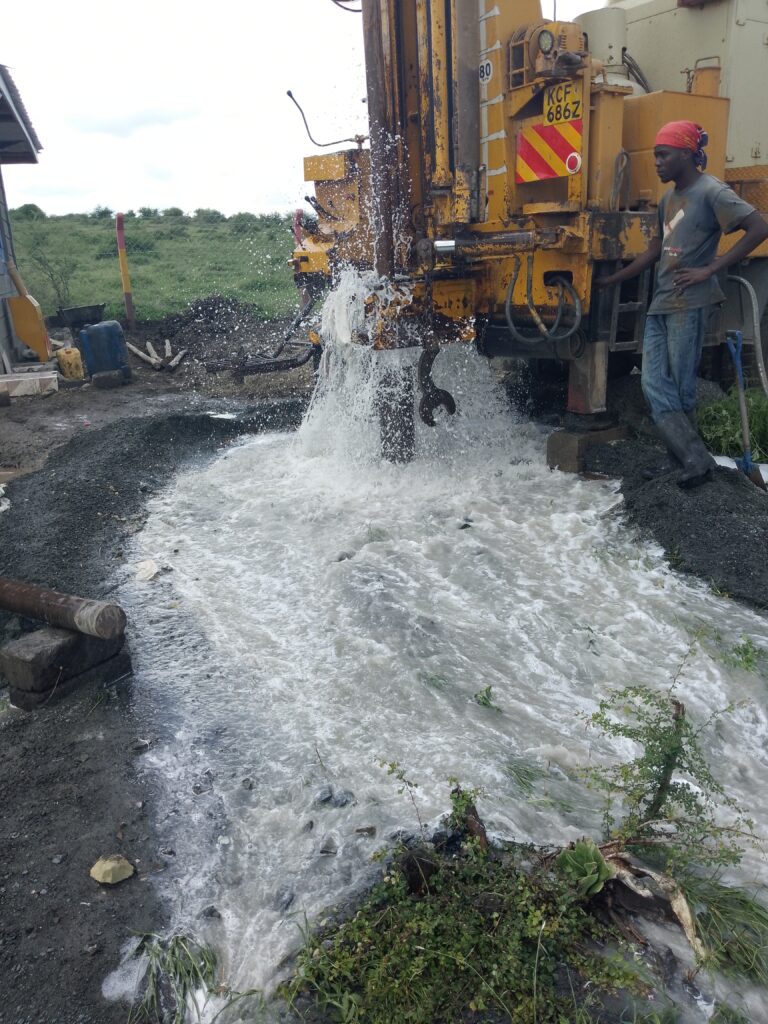
Step 8: Drill With a WRA-Licensed Contractor
Only WRA-licensed drilling contractors are allowed to drill boreholes. Before hiring, verify the licence and ask for references. Throughout drilling, the contractor should:
- Record a drilling log of rock types and water strikes.
- Install casing, screens, gravel pack and a sanitary seal according to the design.
- Develop the borehole and conduct a test pumping to measure yield and drawdown.
- Collect a water sample for laboratory analysis.
Have your hydrogeologist or an independent geologist supervise if possible, because the log and test data will feed into your reports.
Step 9: Submit the Completion Report
After drilling, the contractor submits a borehole completion report to WRA. It documents depth, construction details, water strike levels, static water level, yield and test pumping results and sometimes water quality. This report becomes part of the official record and is needed for the next step.
Step 10: Apply for the Water Abstraction Permit and Install a Meter
Once the borehole is constructed and tested, you apply for the water use (abstraction) permit, which authorises you to pump a defined volume for a defined purpose. A water meter must normally be installed to measure abstraction, and you may be required to submit periodic readings. Permits are issued for a set period and must be renewed. Larger or commercial abstractions may require more detailed assessments.
Typical Costs
Fees depend on the scale and category of use, and they have been subject to proposals for change. Published guides in 2025 and 2026 indicate:
- Application and permit fees in the order of KSh 2,000 to KSh 25,000 for many categories, with some applications involving larger projects reaching tens of thousands of shillings.
- Combined permit, licensing and approval costs for a Nairobi project of roughly KSh 87,000 to KSh 200,000, including NEMA and county requirements.
- Annual abstraction fees from about KSh 3,000 to KSh 25,000 depending on use and volume.
- Hydrogeological survey and report: typically KSh 15,000 to KSh 150,000.
A parliamentary bill (the Water Amendment Bill 2024) proposed removing certain borehole permit fees. Check with WRA for the fee schedule currently in force before budgeting.
How Long Does It Take?
Timelines depend on completeness of your application, county and NEMA processes and workload. For Nairobi, industry guides commonly cite three to six months for the full approval process, though simple domestic cases can be faster. Delays often come from missing documents, unclear coordinates or late county clearances.
Common Reasons Applications Are Delayed or Rejected
- Incomplete documentation, especially missing land ownership proof or tax documents.
- A weak hydrogeological report lacking coordinates, maps or impact assessment.
- Site too close to an existing borehole, river or protected area.
- Missing county no-objection letter or NEMA decision where required.
- Using an unlicensed contractor.
- Starting to drill before authorisation, which can complicate or jeopardise the process.
Tips for a Smooth Application
- Start early, since approvals take months and rig bookings should follow, not precede, authorisation.
- Work with a registered hydrogeologist who knows WRA expectations.
- Keep a document folder (physical and digital) with title, ID, tax certificates, survey report and receipts.
- Follow up politely and regularly with the relevant offices.
- Keep records after drilling: logs, test pumping data, water analysis, meter readings and permit renewals.
- Comply with conditions. Failure can lead to penalties or permit suspension.
Frequently Asked Questions
Can I drill first and apply later? No. Authorisation is required before drilling, and doing otherwise risks fines and enforcement.
Do I need a permit for a borehole used only at home? Domestic boreholes are still subject to regulation, although some requirements such as a full EIA may be simplified. Confirm with WRA and NEMA for your case.
Who can submit the application? You can apply yourself, but many owners use a consultant who prepares the technical and legal documents and tracks the process.
Does the permit last forever? No. Permits are issued for defined periods, and renewal and compliance with conditions are required.
Can I sell water from my borehole? Commercial use usually requires specific permission and, in some cases, additional licensing. Seek advice before selling water.
Conclusion
The WRA (formerly WARMA) permit process in Kenya follows a logical sequence: confirm land rights, commission a hydrogeological survey, obtain county and environmental clearances, apply to WRA, drill with a licensed contractor, submit the completion report, and finally secure the abstraction permit and install a meter. Doing each step in order protects you legally and financially and safeguards the aquifer you depend on.
For hydrogeological reports and support through the permit process, contact Reg. Geol. Mbugua Githae (MGSK) at consult.innercoregeoconsultants.co.ke.