Skip to content

Kenya is among the world’s leading exporters of cut flowers and a major exporter of fresh vegetables and fruit, and much of this production depends on reliable, high-quality irrigation water. A household borehole that supplies a few cubic metres a day is a very different project from a commercial borehole that must supply tens or hundreds of cubic metres every day, year-round, to a farm with greenhouses, packhouses, workers’ housing and strict market and certification requirements.
Commercial boreholes cost more because they involve larger demand, more rigorous hydrogeological work, tighter regulation, higher-capacity equipment, water treatment and storage, and the commercial consequences of failure. This article explains the main cost drivers, gives indicative budgets and shows how to plan intelligently.
A note on figures: all costs below are indicative market ranges drawn from published contractor guides and typical practice, and they vary by region, geology and supplier. Always obtain itemised written quotations.
Step 1: Quantify the Water Demand
You cannot size or cost a commercial borehole without knowing how much water you need. Calculate demand carefully:
- Irrigation demand: depends on crop, area, growing system (soil, substrate, hydroponics), climate, irrigation efficiency and season. Greenhouse flowers and vegetables under drip irrigation commonly use several litres per square metre per day at peak, though actual requirements vary widely by crop and system. For example, 10 hectares of greenhouse production using 5 litres per square metre per day would need about 500 m³ per day (10 ha = 100,000 m², multiplied by 5 L = 500,000 L). Such a figure is illustrative only, and agronomists should provide crop-specific values.
- Post-harvest and packhouse use: washing, cooling and processing.
- Domestic use: staff housing, offices, canteens and sanitation.
- Livestock if any.
- Fire-fighting and contingency storage.
- Growth: plan for future expansion.
Convert demand into peak daily volume and into the pumping rate needed. If your daily need is 300 m³ and you plan to pump 12 hours a day, you need about 25 m³/h. That is a very high borehole yield by Kenyan standards, and one borehole may not deliver it, so you may need several boreholes, storage reservoirs and other sources such as rainwater harvested from greenhouse roofs and river abstraction. Our article on rainwater harvesting versus boreholes explains how roofs can supply a large share of demand.
Step 2: Hydrogeological Investigation (Larger Scope, Higher Cost)
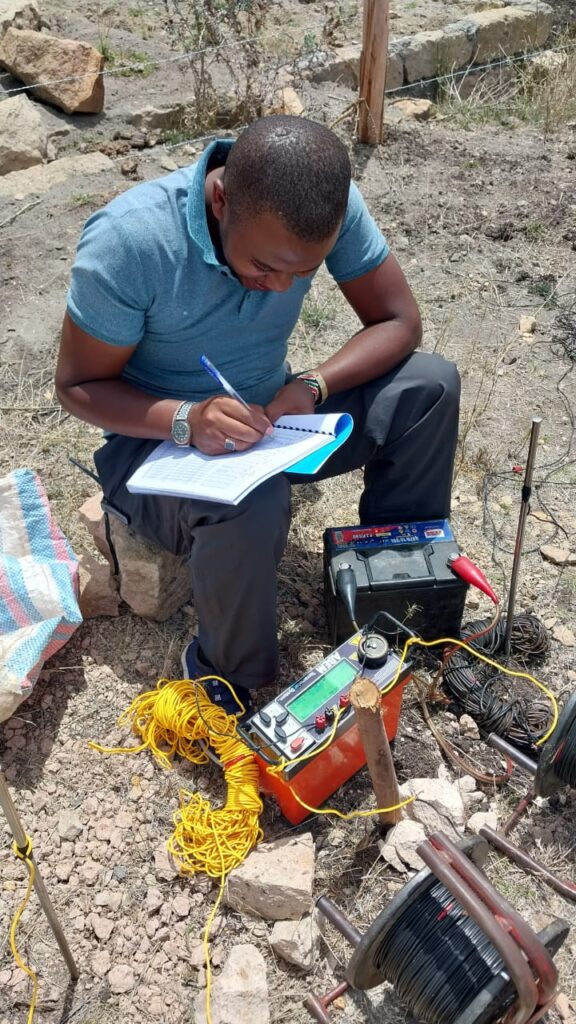
For commercial projects, the hydrogeological investigation is more extensive than for a single household borehole. It typically includes:
- A detailed desktop study and review of regional groundwater conditions and nearby abstraction.
- GIS and remote sensing analysis, including lineaments and groundwater potential mapping across the farm.
- Geophysical surveys (VES, resistivity profiling or tomography, and sometimes electromagnetic surveys) at multiple candidate sites.
- Exploratory drilling in some projects.
- Water quality risk assessment, including fluoride, salinity and nitrate.
- Sustainable yield assessment and interference analysis with neighbouring users.
- A detailed report for regulatory submission.
Costs for a multi-site commercial investigation commonly run from about KSh 150,000 to KSh 300,000 or more, depending on farm size and scope, compared with KSh 15,000 to KSh 150,000 for a standard single-site survey. Given the stakes, this is a small share of the project budget. See our survey cost article.
Step 3: Permits, Environmental Approvals and Compliance
Commercial abstraction invites greater regulatory scrutiny:
- Water Resources Authority (WRA) drilling authorisation and later an abstraction permit specifying volume and use. Larger or commercial uses may attract higher fees and more detailed technical assessment.
- NEMA screening or full Environmental Impact Assessment, which for commercial and larger-volume abstraction is commonly required. EIA studies and licence fees add significant cost and time.
- County approvals, such as planning permission, where applicable.
- Water meter and reporting requirements.
- Certification-related requirements from buyers and standards schemes, which commonly expect legal water access, responsible water use and water quality monitoring.
Published guides estimate combined permit, licence and approval costs for a Nairobi-area project at roughly KSh 87,000 to KSh 200,000, with higher costs for large-scale or complex projects. Annual abstraction fees depend on volume and category and can be substantial for large abstractions. Fee schedules change, and legislative proposals have sought to reduce certain borehole fees, so verify with WRA. Allow three to six months or longer for approvals.
Step 4: Drilling and Construction Costs
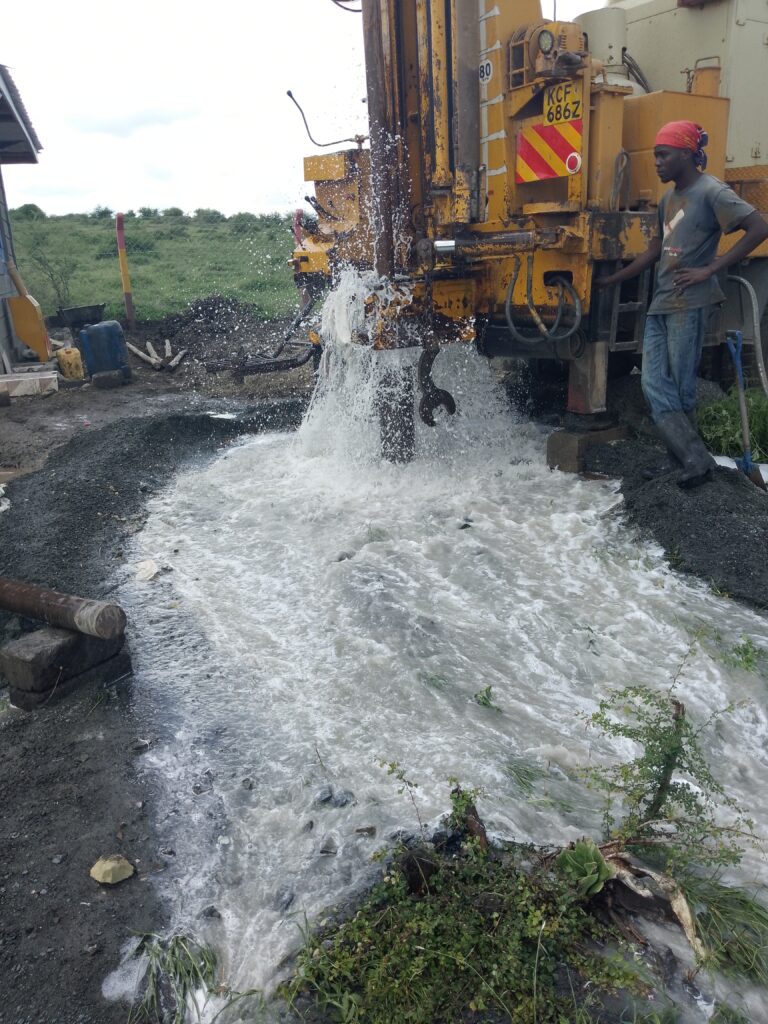
Commercial boreholes are often larger in diameter and deeper than domestic ones to accommodate high-capacity pumps and to intersect more aquifer thickness. Drilling cost components include:
- Mobilisation and demobilisation: roughly KSh 30,000 to KSh 70,000 or more for large rigs.
- Drilling per metre: commonly about KSh 6,500 to KSh 9,500 per metre in the Nairobi area for standard air-rotary drilling, with mud drilling in unstable formations at KSh 14,000 to KSh 15,000 or more per metre. Larger diameters cost more per metre.
- Casing and screens: roughly KSh 1,500 to KSh 5,000 per metre depending on material and diameter, and larger diameters cost considerably more. Stainless steel or heavy-duty casing in aggressive water increases the budget.
- Gravel pack and development: hundreds of shillings per metre for gravel pack and tens to hundreds for development, with larger boreholes requiring more extensive development.
- Test pumping: step and constant-rate tests of longer duration for commercial permits, costing more than a basic domestic test.
Illustrative drilling-only budget for a 250-metre commercial borehole: at KSh 7,500 per metre, drilling alone is about KSh 1.9 million. Add casing and screens (for example KSh 800,000 to KSh 1.2 million for large diameter), gravel pack and development (KSh 100,000 to KSh 250,000) and mobilisation and test pumping (KSh 150,000 to KSh 400,000). A realistic drilling and completion budget could therefore be KSh 3 million to KSh 4 million, before equipping, permits and treatment.
Step 5: Pumping, Power and Controls
Commercial pumping systems are much larger than domestic ones:
- Submersible pump: sized to the required flow and the total head. High flow and deep pumping levels need powerful pumps and motors, costing from several hundred thousand shillings to well over a million.
- Power source: options are grid connection, diesel generator or solar. Grid connection requires transformers and line extension in some areas, which can be costly. Generators have fuel and maintenance costs. Solar pumping has high capital cost for large pumps but low running cost, and often a hybrid with grid or generator is used for reliability.
- Variable frequency drives (VFDs) and control panels to control pumping rates, protect equipment and match flow to demand.
- Protection and monitoring: dry-run protection, level sensors, flow meters, pressure sensors and data loggers.
- Rising main, cables and installation.
- Water meters, required by regulation.
Contractor price lists indicate full equipping from around KSh 800,000 to KSh 1.5 million or more for deeper boreholes with solar, and commercial systems can exceed that substantially. Large solar arrays and storage for farm-scale pumping can push the equipping cost into several million shillings.
Step 6: Storage, Treatment and Distribution
A commercial borehole rarely feeds crops directly. The farm typically needs:
- Storage reservoirs or tanks to buffer supply and demand, provide pressure, allow settling and treatment and give reserve for outages. Lined reservoirs or large tanks may cost from hundreds of thousands to several million shillings depending on volume. Storage lets you pump at a steady, sustainable rate rather than matching peak demand instantly.
- Filtration and treatment: sand and disc filters to protect drip systems, iron and manganese removal, softening or acid injection to control scaling, and disinfection where needed. Where groundwater has high salinity or fluoride, more advanced treatment such as reverse osmosis may be needed, which has high capital and running costs.
- Fertigation and dosing systems for nutrient delivery.
- Mainlines, pumps and distribution networks to blocks and greenhouses.
Water quality drives treatment cost. Flower and vegetable crops can be sensitive to salinity, sodium, boron, bicarbonate and iron, so test the borehole water early and consult an agronomist. Our water quality article lists the key parameters. In the Rift Valley, where flower farms are concentrated around Naivasha and Nakuru, high fluoride and sodium in groundwater are well documented, and these affect worker drinking water, livestock and soil sodicity if irrigation water is not managed.
Indicative Budget Examples
The following examples are illustrative and not quotations. They show how components combine.
Example A: Small-to-medium vegetable or flower farm (one 150 to 200 m borehole, around 8 to 12 m³/h).
| Item | Indicative cost (KSh) |
|---|---|
| Hydrogeological survey and report | 100,000 to 250,000 |
| Permits, NEMA and county approvals | 100,000 to 300,000 |
| Drilling and completion (about 180 m) | 1,800,000 to 2,800,000 |
| Pump, solar and controls | 1,500,000 to 3,000,000 |
| Storage and basic filtration | 500,000 to 2,000,000 |
| Water analysis and monitoring setup | 50,000 to 150,000 |
| Approximate total | about 4 million to 8.5 million |
Example B: Large commercial farm (two to four boreholes, with reservoirs and treatment). Costs scale with the number of boreholes, depth, pumping capacity and storage. Total investment can range from tens of millions of shillings, particularly when large reservoirs, treatment plants, solar arrays and distribution networks are included. A farm may spread investment over phases and combine groundwater with rainwater harvesting from greenhouse roofs to reduce borehole size.
Both examples are indicative. Actual costs depend on geology, depth, yield, site access, equipment choices and market conditions.
Running Costs and Lifecycle Costs
Capital cost is only part of the picture:
- Energy: often the largest recurring cost for deep, high-volume pumping. Solar reduces energy bills but needs maintenance.
- Abstraction permit fees and compliance costs.
- Maintenance and repairs: pumps, motors, controllers, filters and meters. Submersible pumps may need replacement every few years depending on water quality and duty.
- Borehole rehabilitation: periodic cleaning or redevelopment if clogging occurs. See our rehabilitation article.
- Water treatment consumables: filter media, membranes, chemicals.
- Monitoring: water level, abstraction, quality testing and reporting.
- Labour and management.
A lifecycle view helps compare options. A cheaper borehole with a poorly sized pump and no storage can cost more over ten years than a well-designed system.
Risk Management for Commercial Operators
Failed or low-yield boreholes. Include contingency (often 15 to 25 percent or more) for deeper drilling, a second attempt or extra development. Rigorous siting reduces risk but cannot eliminate it.
Over-abstraction and interference. Commercial pumping can lower water levels and affect neighbours, creating disputes and regulatory problems. Follow permit limits, monitor water levels and consider joint management with neighbouring users and the local Water Resources Users Association.
Water quality surprises. Test during drilling and test pumping to avoid surprises after investing in equipment.
Regulatory non-compliance. Unpermitted abstraction can lead to penalties, closure orders and loss of certification, so keep permits, meters and records up to date.
Drought and climate variability. Combine groundwater with rainwater harvesting storage and efficient irrigation to reduce dependence on one source.
Single-point failure. Install redundancy such as spare pumps, backup power and storage buffers.
How to Reduce Costs Without Reducing Reliability
- Invest in a thorough hydrogeological study first. It reduces the risk of drilling failures and over-sized equipment.
- Harvest rainwater from greenhouse roofs to cut the groundwater you need.
- Improve irrigation efficiency with drip irrigation, scheduling, sensors and recirculation systems, which can reduce demand substantially.
- Use storage to flatten the pumping rate so that smaller pumps and boreholes can meet peak demand.
- Choose solar or hybrid power where the economics support it.
- Get several itemised quotations from licensed contractors and compare scopes.
- Have an independent hydrogeologist supervise drilling and test pumping.
- Plan maintenance and monitoring to prevent costly failures.
- Phase the project so you can verify yield and quality before committing to the full system.
Frequently Asked Questions
How many boreholes does a flower farm need? It depends on water demand, borehole yield and other sources. A hydrogeological study and farm water balance determine the number.
Can a farm sell excess water? Commercial water supply typically requires specific authorisation and may involve additional licensing, so seek advice before selling water.
Is a commercial borehole eligible for a lower permit fee? Fees depend on category and volume. Check the current schedule with the Water Resources Authority.
How long does the process take? Planning, surveys, approvals, drilling, testing and equipping often take many months, with approvals being the longest part.
What if groundwater is too saline or high in fluoride for irrigation or workers? Options include treatment, blending with rainwater or surface water, different boreholes or depths, and separate supplies for drinking and irrigation.
Do buyers and certification schemes check water sources? Many require evidence of legal water access and responsible water use. Keep permits, meter records and test results ready.
Conclusion
Borehole costs for commercial horticulture and flower farms in Kenya are driven by demand, depth, yield, regulation, water quality, power and storage. A realistic budget starts with a clear water balance, a thorough hydrogeological investigation and early water quality testing, and continues through compliant permitting, well-designed drilling and equipping, and a plan for monitoring and maintenance. Combining groundwater with rainwater harvesting and efficient irrigation often delivers the most reliable and cost-effective solution.
To plan a sustainable, compliant water supply for your farm, contact Reg. Geol. Mbugua Githae (MGSK) through consult.innercoregeoconsultants.co.ke for hydrogeological surveys, aquifer assessment and permit-ready reports.