Skip to content


Most borehole projects in Kenya fall between KSh 600,000 and KSh 2.5 million when you add up the survey, permits, drilling, casing and test pumping. If you also equip the borehole with a submersible pump, solar array, control panel, tank and tower, the full “water on tap” cost often rises to KSh 1.5 million to KSh 4 million or more, depending on depth and flow rate.
Published contractor price guides in 2026 quote drilling at roughly KSh 6,500 to KSh 9,500 per metre in Nairobi and its surroundings, while broader national ranges stretch from about KSh 1,600 to over KSh 11,500 per metre. That gap is huge, and the reason is geology, not just profit margins. Understanding why will help you budget correctly and avoid expensive surprises.
Why Borehole Costs Vary So Much Across Kenya
A borehole is a narrow, engineered well that taps an aquifer, a rock or sediment layer that stores and transmits groundwater. Kenya’s aquifers sit in very different rocks:
- Volcanic rocks around Nairobi, Kiambu, Nakuru and Mount Kenya (lavas, tuffs, ashes).
- Sedimentary basins along the coast and in parts of the north-east.
- Basement complex rocks (very old metamorphic rocks) in Machakos, Kitui and parts of western Kenya.
Hard, abrasive lavas wear drill bits quickly. Loose sands and clays collapse and may require mud drilling and heavier casing. Deep static water levels mean more metres drilled before you ever “hit” water. All of this changes the price per metre and the total depth.
Cost Component 1: Hydrogeological Survey
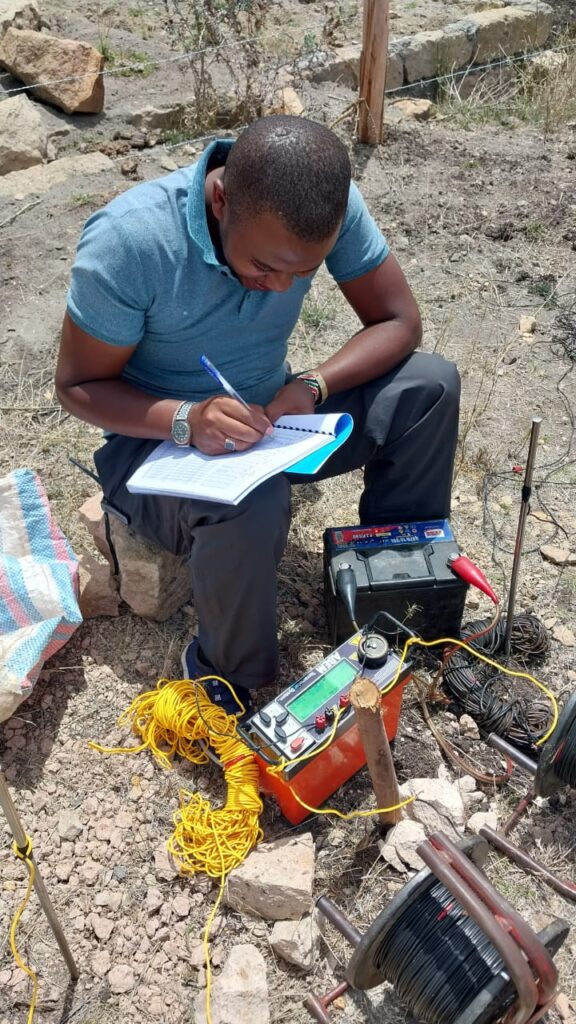
The survey is the first and cheapest line item, and it reduces the biggest risk, drilling a dry hole. A hydrogeologist studies geological maps, nearby borehole records, satellite imagery and often runs a geophysical test such as Vertical Electrical Sounding (VES) to estimate where water-bearing layers lie.
Published ranges vary by location and scope:
- Basic surveys: about KSh 15,000 to KSh 40,000 in some areas.
- Fuller surveys with a formal report suitable for permit submission: commonly KSh 50,000 to KSh 150,000, with some bundled packages around KSh 100,000 that include statutory processing.
The report is not optional in practice. The Water Resources Authority (WRA) expects a hydrogeological report with a drilling application, so the survey is both a scientific and a legal step.
Cost Component 2: Permits, Approvals and Environmental Compliance
Drilling a borehole in Kenya is regulated under the Water Act 2016 and the Water Resources Regulations. Typical steps and costs include:
- WRA drilling authorisation and later a water abstraction (use) permit.
- NEMA approval or screening, because some boreholes, especially commercial ones, may require an Environmental Impact Assessment or at least a screening decision.
- County “no objection” or planning approval in places such as Nairobi, Kiambu and Machakos.
Industry estimates put combined permit and licensing costs for a Nairobi project at roughly KSh 87,000 to KSh 200,000, with registration fees of about KSh 1,000 to KSh 5,000 and annual abstraction fees ranging from about KSh 3,000 to KSh 25,000 depending on use and volume. Proposed legislation (the Water Amendment Bill 2024) sought to remove some borehole permit fees, so confirm current rates with WRA before budgeting.
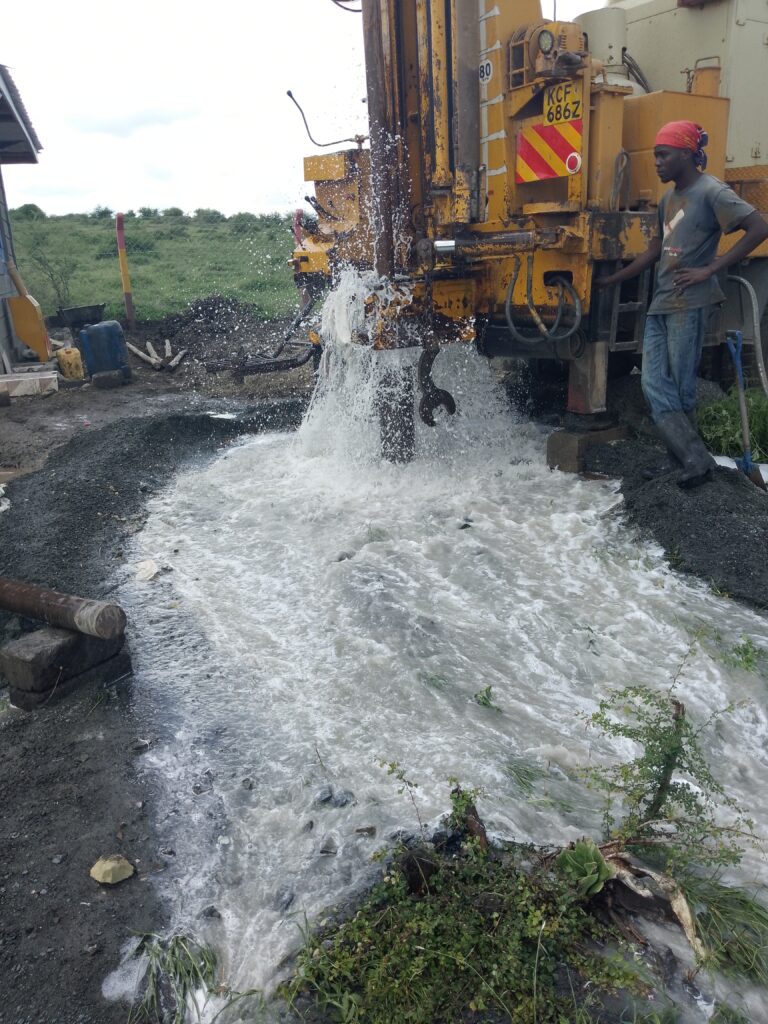
Cost Component 3: Mobilisation and Drilling
Mobilisation is the cost of moving the rig, compressor and crew to your plot. Expect roughly KSh 30,000 to KSh 70,000, more for remote sites.
Drilling itself is charged per metre. Typical 2026 figures:
- Standard air-rotary or down-the-hole (DTH) drilling: about KSh 6,500 to KSh 9,500 per metre in Nairobi area price guides; some contractors quote lower in other counties and higher for difficult formations.
- Mud drilling (needed in loose or collapsing formations): can reach KSh 14,000 to KSh 15,000+ per metre.
An 80-metre borehole at KSh 6,500 to KSh 7,500 per metre costs around KSh 520,000 to KSh 600,000 for drilling alone, before casing and other items. A 180-metre borehole at KSh 6,500 per metre is about KSh 1.17 million.
Cost Component 4: Casing, Gravel Pack and Development
Once the hole is drilled, it must be lined and finished so it stays open, filters out sand and delivers clean water:
- Casing (plain and slotted/screen): roughly KSh 1,500 to KSh 5,000 per metre depending on material (uPVC vs steel) and diameter.
- Gravel packing: about KSh 200 to KSh 600 per metre.
- Well development (surging or air-lifting to remove fine particles): around KSh 50 to KSh 150 per metre.
Cutting corners here is a false economy. Poorly screened or undeveloped boreholes pump sand, wear out pumps and can lose yield over time.
Cost Component 5: Test Pumping and Water Analysis
A test pump determines the borehole’s safe yield (how much water it can supply without drawing down the water level dangerously). Test pumping typically adds about KSh 200 to KSh 500 per metre or a lump sum, and many contractors include a 24-hour test in their package. A laboratory water analysis (see our guide on borehole water quality testing) is usually a few thousand to tens of thousands of shillings depending on parameters.
Cost Component 6: Equipping the Borehole
This is where budgets often double. After drilling, you need:
- A submersible pump sized to the yield and depth.
- A power source: grid electricity or a solar pumping system.
- Rising main pipes, cables, control panel, water meter and sanitary seal.
- A storage tank and tower, plus reticulation.
Contractor price lists put full equipping from around KSh 800,000 up to KSh 1.5 million or more for deeper boreholes with solar. A water meter is generally required by the regulator.
Indicative Cost Table (2026 Market Ranges)
| Item | Typical range (KSh) |
|---|---|
| Hydrogeological survey and report | 15,000 to 150,000 |
| Permits, EIA/NEMA, county approvals | 87,000 to 200,000 (combined, varies) |
| Mobilisation | 30,000 to 70,000 |
| Drilling per metre (air rotary) | 6,500 to 9,500 |
| Drilling per metre (mud) | 14,000 to 15,000+ |
| Casing per metre | 1,500 to 5,000 |
| Gravel pack per metre | 200 to 600 |
| Development per metre | 50 to 150 |
| Test pumping | 200 to 500 per metre or lump sum |
| Pump, solar, tank, tower (equipping) | 800,000 to 1,500,000+ |
These figures are compiled from published contractor and industry price guides and are indicative only. Always request a written, itemised quotation.
Three Sample Budgets
Example A: 80 m domestic borehole, Kiambu. Survey KSh 60,000, permits KSh 100,000, drilling and completion about KSh 900,000 (including casing and testing), basic solar equipping KSh 700,000. Total: roughly KSh 1.8 million.
Example B: 180 m borehole, Nairobi. Survey KSh 100,000, permits and EIA KSh 150,000, drilling at KSh 6,500 per metre KSh 1.17 million, casing and gravel pack KSh 400,000, equipping KSh 1.2 million. Total: roughly KSh 3 million.
Example C: 250 m commercial borehole, Rift Valley. Higher survey and EIA costs, drilling above KSh 2 million, plus a high-capacity pump and possible water treatment (for example, defluoridation). Total: often KSh 4 million and above.
How Geology and Depth Change the Price
Depth is the single biggest cost driver. In Nairobi’s volcanic terrain, productive aquifers are often found at depths of 150 to 300 metres, while in some basement areas water may be struck shallower but yields are lower and fractures can be hit-and-miss. Every extra 50 metres adds roughly KSh 325,000 to KSh 475,000 at standard rates before casing.
Hard rock slows drilling, increasing rig hours and bit wear. Unstable formations may need mud drilling or temporary casing. This is why a survey that predicts the likely geology saves real money: it helps you and your contractor plan the right method, depth and casing design.
Hidden and Recurring Costs Owners Forget
- Failed or dry holes: if the first attempt does not yield, you may still pay per metre drilled. A proper survey cuts this risk but cannot eliminate it, because hydrogeology always carries uncertainty.
- Water treatment: in parts of the Rift Valley, fluoride is a common problem (see our fluoride article), and treatment can add substantial cost.
- Annual permit renewals and meter reading/reporting.
- Pump maintenance and replacement: submersible pumps typically need servicing and may be replaced every few years depending on water quality and use.
- Electricity or solar maintenance.
Seven Ways to Control Borehole Costs Without Cutting Quality
- Commission an independent hydrogeological survey first. The survey costs a fraction of one failed hole.
- Get at least three itemised quotations that list per-metre rates, casing type, mobilisation and what is included in test pumping.
- Check licences. Only WRA-licensed drilling contractors may legally drill boreholes.
- Size the pump to the tested yield, not to a guess. Oversized pumps waste money and can damage the aquifer.
- Consider solar if you have strong daytime demand; it reduces running costs even if capital cost is higher.
- Share the borehole with neighbours where regulations and demand allow.
- Schedule drilling in the dry season when water levels are lowest, so the borehole is designed conservatively.
Red Flags in Borehole Quotations
- A price per metre that is far below the market with no explanation.
- No mention of casing material, diameter or screen length.
- “Guaranteed water” promises. No honest hydrogeologist can guarantee water, only improve the odds.
- Pressure to skip the hydrogeological survey or permits.
- No test-pumping report or water analysis in the package.
Frequently Asked Questions
Is it cheaper to drill in some counties than others? Yes. Costs differ with rig availability, distance, and geology. Remote or arid areas add mobilisation costs, while areas with hard lava or deep water tables raise per-metre prices.
Do I pay if no water is found? It depends on your contract. Many contractors charge for metres drilled regardless of outcome, which is why the survey and a clear agreement matter.
How long does the whole process take? Permit processing in a city like Nairobi commonly takes three to six months, while the drilling itself often takes one to three days for a typical domestic borehole.
Can I drill without a hydrogeological survey? Technically you would not be able to complete the permitting properly, and you would be gambling with a seven-figure investment.
Conclusion: Budget Smart, Drill Once
Borehole drilling in Kenya is a significant but manageable investment when you plan around the science. Expect roughly KSh 600,000 to KSh 2.5 million for the borehole itself and more for equipping, with depth, geology, drilling method and compliance driving the final figure. Start with a professional hydrogeological survey, insist on itemised quotations, and make sure every permit is in place before the rig arrives.
Need a hydrogeological survey, borehole siting or an independent review of your drilling quote? Contact Reg. Geol. Mbugua Githae (MGSK) at consult.innercoregeoconsultants.co.ke for professional hydrogeological and geophysical services across Kenya and the region.