Skip to content

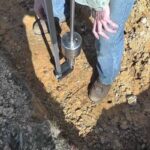
The Standard Penetration Test is an in-situ (field) test performed inside a borehole. A thick-walled steel tube called a split-spoon sampler is driven into the soil at the bottom of the borehole by repeated blows of a standard hammer. The number of blows needed to drive the sampler a set distance is recorded. That number, known as the N-value, is an index of how dense or stiff the soil is.
The test also recovers a disturbed soil sample inside the split spoon, which the engineer uses to identify the soil type. So one operation gives both a strength index and a sample.
A Brief History
The SPT was developed in the United States in the 1920s and 1930s, and standardised over the following decades. It spread globally because it is simple, fast, robust, and cheap, and it can be performed with basic drilling equipment. Standards such as ASTM D1586 and ISO 22476-3 describe the procedure, and local practice in Kenya generally follows British or American conventions.
How the Test Is Done
The procedure is straightforward. The drilling crew advances the borehole to the test depth and cleans out the bottom. The split-spoon sampler is attached to drill rods and lowered to the bottom. A hammer weighing 63.5 kg (140 lb) is raised and dropped from a height of 760 mm (30 inches) onto the rods, driving the sampler into the soil.
The sampler is driven a total of 450 mm in three increments of 150 mm each. The blows for the first 150 mm are the “seating drive” and are disregarded because the bottom of the borehole may be disturbed. The blows for the next two 150 mm increments are added together, and that total is the SPT N-value (blows per 300 mm). The test is usually repeated at intervals of about 1 to 1.5 metres, or when the soil changes.
What Is “Refusal”?
If the sampler cannot advance a given distance after a large number of blows (commonly 50 blows), the test is stopped and called refusal. The report records the penetration achieved for those blows. Refusal usually indicates very dense soil, cemented layers, boulders, or rock. In Kenya’s volcanic and weathered rock areas, refusal is common at depth, and it is important to interpret whether it reflects true bedrock or a hard layer above softer material.
How to Read N-Values
As a rough guide, for sands and non-cohesive soils, low N-values mean loose soil and high values mean dense soil. Very loose sands have N below about 4, loose sands about 4 to 10, medium dense about 10 to 30, dense about 30 to 50, and very dense above 50.
For clays and cohesive soils, N-values indicate consistency: very soft clay is below about 2, soft about 2 to 4, medium stiff about 4 to 8, stiff about 8 to 15, very stiff about 15 to 30, and hard above 30. These classes are approximations. The correlations between N and soil strength are empirical and are less reliable in clays than in sands.
From N-Value to Engineering Parameters
Engineers use correlations to estimate soil properties from N: the angle of internal friction in sands, undrained shear strength in clays, relative density, and an allowable bearing pressure for shallow foundations. Classic relationships by Terzaghi and Peck, Meyerhof, and others are still in use, often as part of a broader analysis.
Because the test is empirical, the N-value is typically corrected for factors such as hammer energy efficiency, rod length, borehole diameter, and the effect of overburden pressure. Reports may show raw N, corrected N60 (adjusted to 60 percent energy efficiency), or N1(60) (also normalised for overburden). If a report does not state which is used, ask the engineer.
Why the SPT Is So Popular
The SPT is valued for several reasons. It is cheap and quick compared with advanced tests. It uses widely available equipment and trained crews. It gives a sample for classification. It has an enormous global database of correlations and experience, which engineers know how to interpret. For routine building foundations in Kenya, it is often the primary in-situ test.
Limitations You Should Know
The SPT also has limitations. Results are sensitive to equipment and operator practice: hammer type, rope and pulley arrangement, and borehole cleaning can change the N-value significantly. Disturbance at the bottom of the hole, or water flowing upward into the borehole in sand (heave), can produce misleading results.
The test is not well suited to very soft clays, where the sampler may sink under its own weight, or to gravelly soils and boulder layers, where large particles block the sampler and give artificially high N-values. In expansive black cotton soils, N-values may look good in dry conditions but the soil can still swell and lose strength when wet, so SPT alone cannot characterise the risk. It is a screening and design index, not a complete picture, and it should be combined with laboratory testing.
SPT in Kenyan Conditions
In Nairobi’s volcanic tuffs and weathered trachytes, SPT can help identify where the ground becomes competent for foundation bearing. In the coastal region, SPT helps assess loose sands, coral deposits, and liquefaction potential. In Lake Victoria basin clays and black cotton soils, the SPT should be supplemented with Atterberg limits and swell tests. In weathered basement terrains, SPT helps define the transition from residual soil to rock.
Good practice is to log water levels, record the equipment used, and have an engineer or engineering geologist supervise the field work.
Tips for Clients Reading an SPT Log
Look for the depth profile of N-values, noting where N increases significantly. Check the groundwater level. Look at soil descriptions beside each test. Watch for sudden drops in N below a high value, which may indicate a weak layer under a crust. Note refusal depth and what the engineer says about it. Finally, confirm that the recommended bearing pressure is consistent with the data and that the founding level matches the competent layer.
Frequently Asked Questions
Is a higher N always better? Generally yes for strength, but very high values from gravel or boulders may be misleading.
Can SPT be done in rock? It is mainly for soils and weathered rock. Rock is usually assessed by coring and strength tests.
Is SPT enough on its own? Usually not. It works best together with sampling, laboratory tests, and engineering judgement.
A Worked Example of Reading SPT Data
Imagine a borehole log in a Nairobi suburb. From the surface to 1.5 metres, the soil is soft dark clay with N-values of 3 to 5, which is low and typical of a weak, possibly expansive surface layer. From 1.5 to 4 metres, the soil becomes stiff clay with N-values rising from 8 to 14. Between 4 and 7 metres, weathered tuff appears with N-values of 25 to 40, and at 8 metres the test reaches refusal at 50 blows for 40 mm penetration.
An engineer reading this would recognise that shallow footings in the top 1.5 metres would sit on weak soil, and that a more competent layer exists from about 4 metres. Depending on building size, the recommendation may be to excavate through the soft layer and found on the stiffer material, to use a raft or piles bearing on the weathered tuff, or to adopt a different solution if the clay is expansive. The SPT profile therefore directly guides the founding level.
Related Tests That Complement the SPT
SPT is rarely used alone. The Dynamic Cone Penetrometer provides quick, continuous strength readings for shallow depths. The Cone Penetration Test gives detailed, continuous profiles in soft soils. Vane shear tests measure the undrained strength of soft clays directly. Pressuremeter and plate load tests provide stiffness and bearing data. Laboratory tests such as Atterberg limits, shear strength, and consolidation fill in the details that a blow count cannot reveal. Together they give a more reliable ground model than any single test.
Key Takeaways
Keep these points in mind when you next see SPT data. The N-value is an index, not a direct measure of strength. It depends on equipment and procedure, so corrected values and test conditions should be stated. It works best in sands and stiff clays, and less well in gravel, very soft clay, and expansive soil. And it is always more powerful when combined with sampling, laboratory tests, and local geological knowledge. With that perspective, an SPT log becomes a readable story about the ground rather than a column of mysterious numbers.
Conclusion
The Standard Penetration Test is a simple, practical method for judging the density or stiffness of soil and sampling it at the same time. Understanding how it works, what N-values mean, and where it falls short helps you ask better questions of your engineer and read your soil report with confidence. In Kenya’s varied ground, the SPT remains a trusted tool, provided it is performed carefully and interpreted together with other evidence.