Skip to content
A pumping test produces, on the surface, a fairly simple dataset: water levels measured over time while a borehole is pumped at a controlled rate. But buried in that drawdown curve is some of the most valuable information a hydrogeologist can extract about an aquifer — its capacity to transmit water, its capacity to store water, and ultimately, how much water can be sustainably withdrawn without depleting the resource. Learning to read that curve correctly is what turns a routine field test into genuine engineering insight.
What a Pumping Test Actually Measures
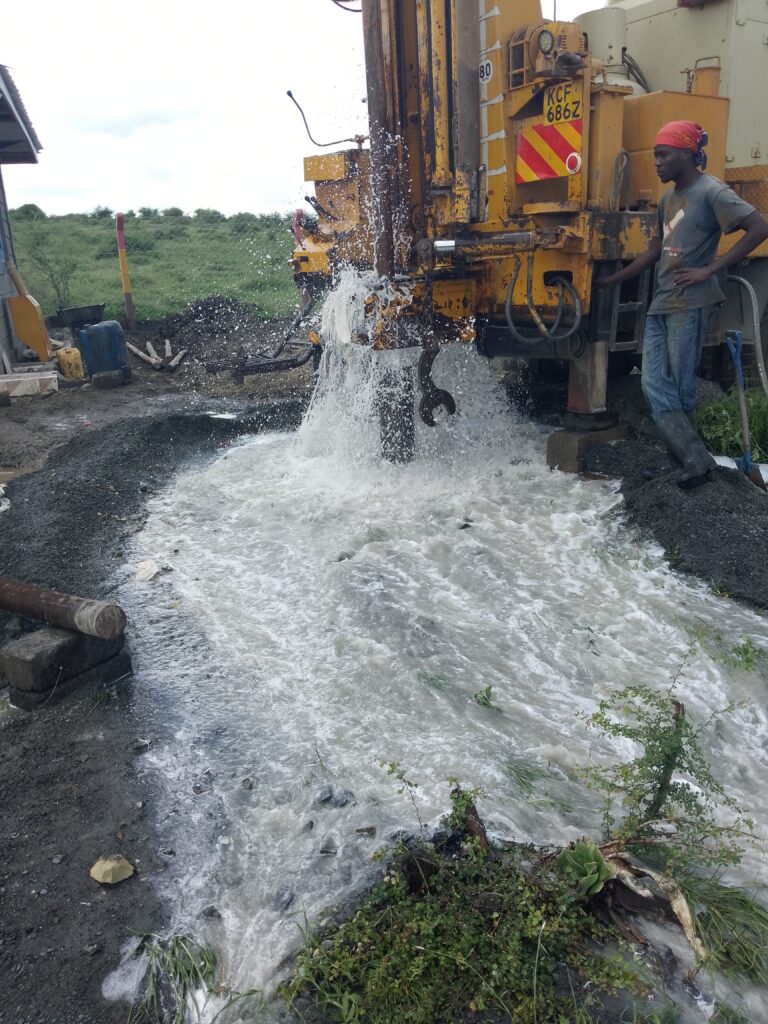
During a pumping test, water is withdrawn from a borehole at a known, controlled rate while water levels are monitored — in the pumped borehole itself, and ideally in one or more nearby observation wells. As pumping continues, a cone of depression forms around the borehole: water levels drop most sharply near the pumped well and progressively less with distance away from it. The shape and evolution of this drawdown pattern over time encodes information about how the aquifer responds to stress, which analytical methods can translate into quantifiable hydraulic parameters.
The Key Parameters Being Estimated
Transmissivity (T)
Transmissivity describes how effectively water moves horizontally through the full saturated thickness of an aquifer — essentially, the aquifer’s overall capacity to transmit water toward a pumping well. Higher transmissivity means water can flow toward the well more readily, generally supporting higher sustainable pumping rates without excessive drawdown.
Storativity (S)
Storativity (or storage coefficient) describes how much water an aquifer releases from storage per unit decline in hydraulic head, per unit area. Confined aquifers typically have very low storativity values, since water release comes primarily from the compressibility of the aquifer material and the water itself, while unconfined aquifers have much higher storativity, since water is released through actual dewatering of pore space as the water table drops.
Hydraulic Conductivity (K)
Related to transmissivity but normalized by aquifer thickness, hydraulic conductivity describes the intrinsic ease with which water moves through the aquifer material itself, independent of how thick the saturated zone is — useful for comparing the water-transmitting properties of different geological materials directly.
Specific Capacity and Sustainable Yield
Specific capacity — the pumping rate divided by the resulting drawdown — provides a practical, field-derived measure of well performance, while sustainable yield represents the pumping rate a well can maintain over the long term without excessive drawdown or aquifer depletion, typically derived by extrapolating test results using established analytical or numerical methods.
Common Analytical Methods
Theis Method
Developed in 1935, the Theis solution remains foundational to pumping test analysis, describing drawdown in a confined, homogeneous, infinite aquifer as a function of time and distance from the pumped well. Analysts fit a type curve to observed drawdown data (traditionally through graphical curve-matching, now more commonly through software) to extract transmissivity and storativity values. Theis assumptions — full confinement, infinite lateral extent, homogeneous properties — are rarely perfectly met in real aquifers, but the method remains a widely used starting point, particularly for confined aquifer settings.
Cooper-Jacob Approximation
A simplified version of the Theis method, valid for later-time data once certain conditions are met, the Cooper-Jacob (or “straight-line”) method plots drawdown against the logarithm of time, producing a straight line whose slope and intercept can be used to calculate transmissivity and storativity with considerably less computational effort than full Theis curve-matching — a practical advantage that made it especially popular before modern analysis software became widely available, and one that remains useful today as a quick-check method.
Unconfined Aquifer Methods (Neuman, etc.)
Unconfined aquifers behave differently from confined ones, particularly due to delayed yield — water draining slowly from the unsaturated zone above the water table as it declines, which produces a distinctive three-stage drawdown pattern rather than the simpler curve seen in confined settings. Methods developed specifically for unconfined conditions, such as the Neuman method, account for this delayed yield behavior to produce more accurate parameter estimates than confined-aquifer methods would give if misapplied.
Test Design Considerations That Affect Reliability
The quality of pumping test analysis depends heavily on how the test itself is designed and executed. Test duration matters significantly — a test that’s too short may not reach the flow regime needed for reliable long-term parameter estimation, particularly in unconfined aquifers where delayed yield effects can take many hours to fully manifest. Observation wells, when available, dramatically improve analysis reliability compared to relying solely on drawdown measured in the pumped well itself, since pumped-well data can be affected by well losses (turbulent flow effects near the borehole) that don’t reflect true aquifer behavior. Constant discharge rate throughout the test is essential, since most standard analytical methods assume a steady pumping rate; a poorly regulated pump introduces noise that complicates interpretation.
Step-Drawdown Tests: A Complementary Approach
Distinct from a standard constant-rate test, a step-drawdown test pumps a well at several progressively increasing rates, each held for a shorter period, primarily to characterize well efficiency and well losses rather than aquifer-wide parameters. Step tests are often run before a full constant-rate test specifically to help determine an appropriate pumping rate for the longer test that follows, making efficient use of limited field time and avoiding a constant-rate test run at a rate the well can’t actually sustain.
Practical Application to Sustainable Water Supply Design
The ultimate purpose of pumping test analysis, in most groundwater development contexts, is translating these hydraulic parameters into a defensible, sustainable pumping rate recommendation — one that balances the water supply need against the aquifer’s demonstrated capacity to support it without excessive long-term drawdown or depletion. This recommendation should account for seasonal recharge variability and, where relevant, the cumulative effect of other nearby abstraction points drawing from the same aquifer system, since a rate that appears sustainable in isolation can prove otherwise once combined with neighboring wells’ demand on a shared resource.
The Bottom Line
Pumping test analysis is where fieldwork and quantitative hydrogeology meet: a well-designed, properly monitored test, interpreted with an analytical method appropriate to the actual aquifer conditions, converts a simple water-level record into genuine engineering knowledge about how much water a resource can reliably provide. Skipping proper analysis — or applying a confined-aquifer method to unconfined conditions, a common and consequential error — risks a sustainable yield estimate that looks precise on paper but doesn’t hold up once the borehole is actually put into long-term service.