Skip to content


Drilling a borehole tells you that water exists. Test pumping tells you how much water you can safely take. Without a proper pumping test, choosing a pump, designing storage, applying for an abstraction permit or planning irrigation is guesswork. Pumping tests are therefore a core part of any borehole project, and a requirement in practice for permits from the Water Resources Authority (WRA).
A pumping test involves pumping the borehole at controlled rates while measuring how the water level falls (drawdown) and then recovers. These measurements reveal both the performance of the borehole itself and the characteristics of the surrounding aquifer.
Key Terms Explained Simply
- Static water level (SWL): the water level in the borehole before pumping begins.
- Pumping water level (PWL): the level while pumping.
- Drawdown (s): the difference between static and pumping water levels. If SWL is 40 m and PWL is 55 m, drawdown is 15 m.
- Yield (Q): the volume of water pumped per unit time, usually in cubic metres per hour (m³/h) or litres per second.
- Specific capacity (Q/s): yield divided by drawdown, a quick indicator of borehole productivity. Higher is better.
- Transmissivity (T): how much water the aquifer can transmit through its full thickness, a key aquifer property.
- Storativity (S): how much water the aquifer releases from storage per unit drop in water level.
- Recovery: the rise of the water level after pumping stops.
- Safe yield (sustainable yield): the rate at which water can be pumped long term without causing unacceptable declines in water level, damage to the aquifer or interference with other users.
What Happens During Aquifer Pumping
When a pump removes water from a borehole, the water level in the borehole drops, creating a pressure difference that draws water from the surrounding aquifer toward the borehole. The area where the water level is lowered is called the cone of depression. Its size and shape depend on the pumping rate, duration and aquifer properties. In a thick, permeable aquifer the cone is shallow and wide. In a tight, fractured aquifer the cone is steep and may expand quickly to hydraulic boundaries such as fault zones or low-permeability margins.
Drawdown in a pumping borehole has two components: aquifer loss, caused by flow through the aquifer, and well loss, caused by turbulent flow through the screen, gravel pack and casing. Poor borehole construction increases well loss and reduces efficiency, which is one reason development is important.
Types of Pumping Tests
1. Step-drawdown test (step test). The borehole is pumped at a series of increasing rates, typically three to five steps, each lasting a fixed time such as 60 to 120 minutes. The drawdown at the end of each step is recorded. The test reveals how drawdown increases with pumping rate, allowing estimation of well losses and the critical yield, above which drawdown rises disproportionately. It helps choose the rate for the next test.
2. Constant-rate test (CRT). The borehole is pumped at a single constant rate for an extended period, often 24 to 72 hours, with frequent measurements of water level and discharge. This test is the main source for estimating aquifer properties such as transmissivity and for observing boundary effects. For boreholes supporting commercial abstraction, longer tests may be required, and observation boreholes may be monitored.
3. Recovery test. After the pump is switched off, the rising water level is measured until it returns near the original level. Recovery data provide an independent check on transmissivity and are valuable because they are not affected by pump rate fluctuations.
4. Multiple-well and long-term tests. For larger water supply schemes, tests may involve observation wells, pumping at multiple boreholes or extended monitoring to assess interference and seasonal behaviour.
A typical domestic or small commercial borehole in Kenya is tested with a step test followed by a 24-hour constant-rate test and a recovery test. Specific durations depend on contractor practice, regulator expectations and project scale.
How a Pumping Test Is Carried Out
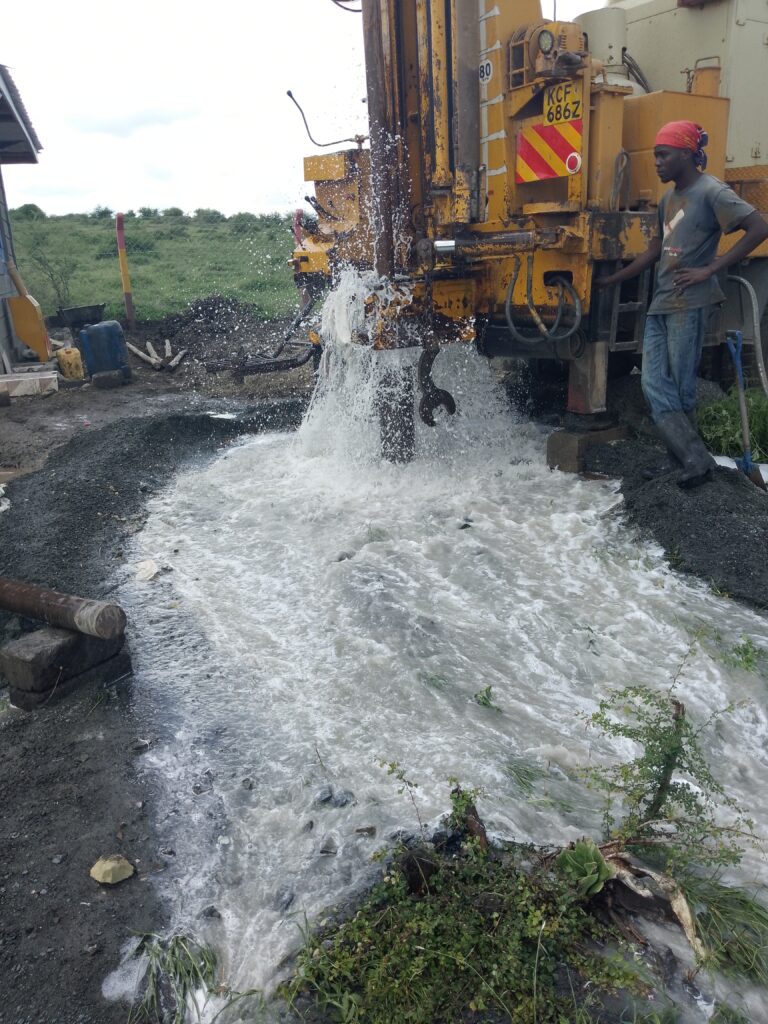
- Preparation. Confirm the borehole is fully developed, install a test pump of appropriate capacity, and set it below the expected lowest pumping level. Arrange a reliable discharge point away from the borehole so pumped water does not recirculate.
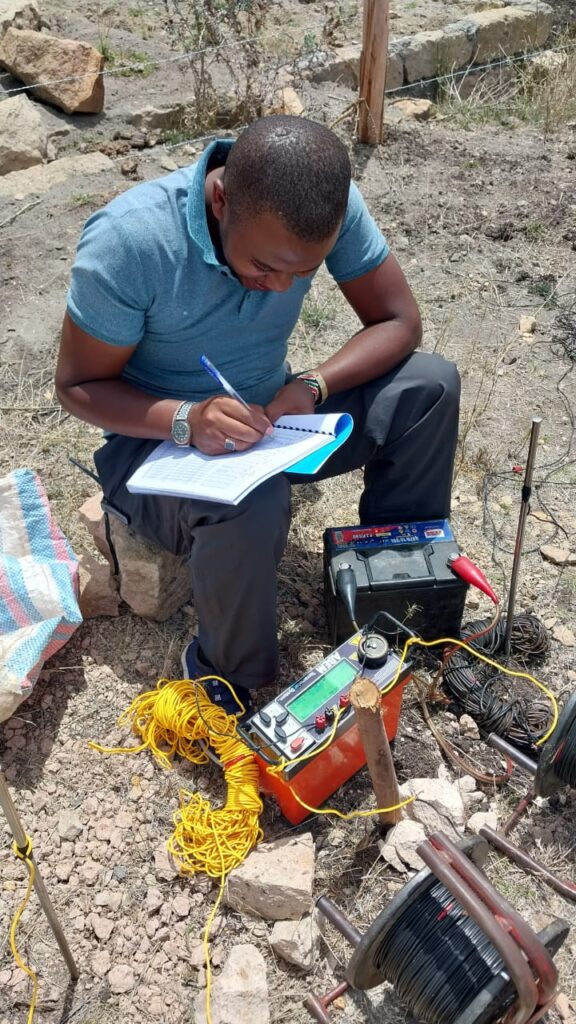
- Measure static water level with a dip meter (electric water level tape) and record the time.
- Install measurement tools: an accurate flow meter or calibrated container or orifice weir to measure discharge, a stopwatch or logger, and a clear data sheet.
- Start the step test. Set the first rate, record drawdown at frequent intervals (for example every minute initially, then at longer intervals), and move to the next step at the scheduled time.
- Allow recovery after the step test before beginning the constant-rate test, so you start from a stable level.
- Run the constant-rate test, maintaining the discharge steady, and record drawdown at logarithmically increasing time intervals.
- Record recovery after switching off the pump, again with frequent early measurements.
- Collect water samples near the end of pumping for laboratory analysis, since samples after sustained pumping represent aquifer water better than samples from early pumping.
- Document everything: pump depth, discharge rate, times, readings, weather, nearby pumping and any interruptions.
Analysing the Data
Hydrogeologists plot drawdown against time on semi-logarithmic or log-log charts and apply analytical methods such as Theis, Cooper-Jacob or Hantush solutions, selected according to aquifer type (confined, unconfined or leaky) and test behaviour. For fractured rocks, more specialised approaches may be used because flow does not behave like in uniform porous media.
The analysis provides:
- Transmissivity and hydraulic conductivity, indicating aquifer productivity.
- Specific capacity and well efficiency.
- Evidence of boundaries, such as impermeable boundaries that cause drawdown to steepen, or recharge boundaries that stabilise drawdown.
- Long-term projections, such as predicted drawdown after months or a year of pumping at a given rate.
- Recommended safe yield and pump setting depth.
Determining Safe Yield
Safe yield is not simply the maximum rate the pump can deliver for 24 hours. A responsible estimate considers:
- Drawdown stabilisation. If drawdown keeps increasing during the test, the aquifer may not sustain that rate.
- Available drawdown. The distance between static water level and the shallowest productive zone or the pump intake. Pumping should not lower the water level below the main water-bearing zone, since this can cause cascading water and reduced yield.
- Seasonal variability. Water levels fall in dry seasons. Tests during dry periods are more conservative.
- Long-term projections based on analysis.
- Interference with neighbours and the environment.
- Regulatory requirements and permit conditions.
Many practitioners recommend operating below the test rate (for example a fraction of the tested yield) and using limited daily pumping hours to allow recovery. A borehole that tests at 6 m³/h may be recommended for continuous use at a lower rate, or for pumping 10 to 12 hours a day, depending on analysis.
Why Test Pumping Is Important for Permits
The WRA abstraction permit is based on how much water the borehole can sustainably supply. Test pumping data and the completion report are part of the documentation. Without them, a regulator cannot responsibly decide how much abstraction to allow. Our article on getting a groundwater abstraction permit shows where these reports fit.
Choosing the Pump From Test Results
Test results guide pump selection:
- Required flow rate is set by demand but must not exceed safe yield.
- Total dynamic head includes the pumping water level depth plus elevation to the tank and friction losses.
- Pump setting depth must be below the lowest expected pumping level with a safety margin.
- Power source sizing, whether grid, generator or solar, depends on pump power requirements.
Buying a pump before the test is a common mistake. An oversized pump can pump the borehole dry, cause cavitation and damage the borehole.
Interpreting Results: What Is “Good”?
Yields vary widely across Kenya’s aquifers. Some practitioners treat boreholes yielding under 1 m³/h as marginal for anything beyond small domestic use, 1 to 5 m³/h as adequate for households and small farms, and above 5 to 10 m³/h as good for irrigation or institutional use, with exceptional boreholes exceeding 20 m³/h. These are rough guides only. What counts as good depends on your demand. A school needing 20 m³ per day can be served by a borehole sustainably yielding 2 to 3 m³/h pumped for several hours daily, with storage.
Common Problems in Pumping Tests
- Test too short. A brief test may overestimate yield because boundary effects appear later.
- Inaccurate flow measurement. Errors in discharge lead to errors in all derived properties.
- Fluctuating pump rate due to power supply issues or throttling.
- Interference from neighbouring pumping, which can distort drawdown.
- Recirculation of discharge water back into the aquifer.
- Poor water level measurement, for example reading the dip meter inconsistently.
- Testing before development is complete, which gives misleading results and sand pumping.
- Ignoring the dry season. A borehole tested in a wet season may perform poorly in drought.
Water Quality During Testing
Because pumped water is representative of aquifer conditions, tests should also monitor basic field parameters such as electrical conductivity, pH and temperature and collect samples for laboratory analysis. Changes in conductivity during pumping can indicate mixing of different water types, including saline water. For quality parameters like fluoride, hardness and salinity, see our article on borehole water quality testing.
After the Test: Monitoring Over Time
A single test is a snapshot. Good practice includes:
- Regular static water level measurements (monthly, for example).
- Recording abstraction volumes from a meter.
- Periodic retesting if yield appears to decline.
- Noting seasonal changes.
If yield decreases or the pumping water level falls, the cause may be aquifer decline, clogging of the screen, pump wear or neighbouring abstraction. Our articles on why boreholes dry up and borehole rehabilitation explain the diagnosis and remedies.
Frequently Asked Questions
How long should a pumping test last? Common practice for typical boreholes is a step test followed by a constant-rate test of 24 hours or more, plus recovery. Larger abstractions may need longer tests, as required by the regulator or hydrogeologist.
Who should supervise the test? A hydrogeologist or experienced technician. Independent supervision reduces the risk of unreliable data.
Can a borehole fail a pumping test? It may reveal lower yield than expected, which is useful to know. Options include deepening, hydrofracturing in some hard rock settings, developing further, or reducing planned use.
Is the blow yield measured during drilling the same as safe yield? No. Blow yield measures air-lift discharge during drilling and is only a rough indicator. Safe yield comes from proper pumping tests.
Do I need a pumping test for a small domestic borehole? Yes, a basic test is still needed to choose a pump and document yield.
Conclusion
Pumping tests turn a drilled hole into a quantified water source. By measuring drawdown and recovery under controlled conditions, hydrogeologists estimate aquifer properties, determine safe yield, guide pump selection and provide the evidence that regulators need. A well-executed test protects your investment, your aquifer and your neighbours.
For pumping test design, supervision and interpretation, contact Reg. Geol. Mbugua Githae (MGSK) through consult.innercoregeoconsultants.co.ke.