Skip to content

Kenya generates a large share of its electricity from renewable sources, and geothermal energy is the backbone of that success. The reason is geological. Kenya sits on the East African Rift System, where the African plate is slowly pulling apart. As the crust stretches and thins, hot mantle material rises closer to the surface, magma accumulates beneath young volcanoes, and faults and fractures provide pathways for water. The result is a chain of high-temperature geothermal fields along the floor of the Kenya Rift.
Published reviews describe Kenya’s geothermal development as the most successful in Africa. According to a 2025 chapter in a standard geothermal reference book, rifting in the region began in the Oligocene and has continued to the present, and the main geothermal fields are Olkaria, Eburru, Menengai and Paka. Other prospects, including Longonot, Suswa, Korosi, Silali and Baringo, are at various stages of study.
How Much Geothermal Power Does Kenya Have?
Figures change as plants come online, so always check the latest reports. As of reports published in 2026:
- Kenya’s total installed geothermal capacity stood at about 940 MW in an early 2026 report, with KenGen owning roughly four-fifths of it.
- The commissioning of the second 35 MW plant at Menengai, built by OrPower 22, was reported to take Kenya’s installed geothermal capacity above 1,000 MW (1 GW), a major milestone.
- An upgrade of the oldest plant, Olkaria I, from 45 MW to 63 MW was targeted for completion around mid-2026, adding capacity through equipment upgrades.
- Estimates of Kenya’s total geothermal potential vary by source and method, with figures of more than 7,000 MW appearing in a recent academic review and more than 10,000 MW in other published estimates. The differences reflect varying assumptions and the fact that potential estimates are revised as exploration progresses.
Geothermal power is valuable because it is baseload: it runs day and night, in wet and dry seasons, with high availability. That makes it a stabilising complement to hydropower, which varies with rainfall, and to wind and solar, which vary with weather and time of day. See our article comparing geothermal and solar for Kenya’s energy mix.
Olkaria: The Heart of Kenyan Geothermal
Location and geology. The Greater Olkaria geothermal field lies near Lake Naivasha in Nakuru County, within Hell’s Gate National Park and the surrounding area. It is associated with the Olkaria volcanic complex, a cluster of young volcanic centres dominated by rhyolitic (silica-rich) lava domes and pyroclastic deposits, underlain by trachytes, basalts and other volcanic rocks. The area is cut by fault systems, including rift-parallel structures and the distinctive Ol’Njorowa gorge, which are important for permeability. Heat comes from shallow magmatic intrusions beneath the complex.
History and sections. Kenya’s geothermal story is long. The first unit at Olkaria I started operating in 1981, making it the oldest geothermal plant in the country, and the field has since expanded through several sections, commonly named Olkaria I to V. A published review notes that Olkaria accounts for about 920 MW of installed capacity, roughly 95 percent of Kenya’s total at the time of the study, and that more than 300 wells had been drilled in the Greater Olkaria field.
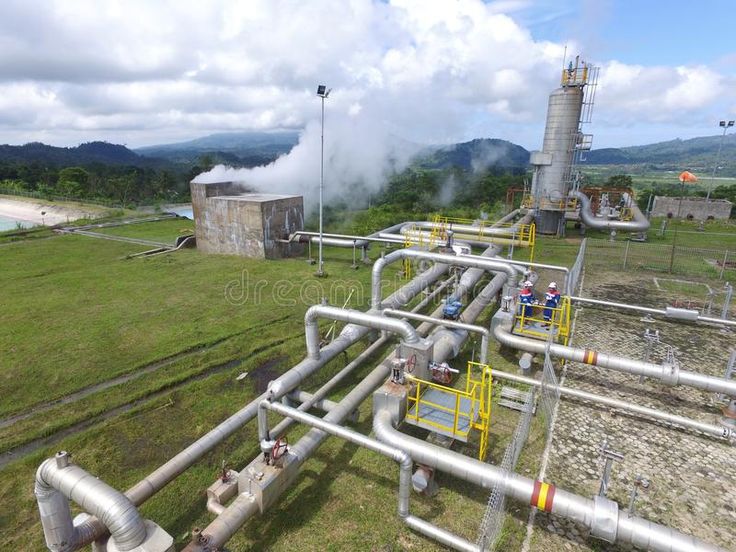
Operators. KenGen, the state-owned generator, operates most of Olkaria’s plants, while independent power producers such as OrPower 4 (Ormat) operate others, and Sosian Energy operates a plant in the Menengai field. The field also supplies steam for emerging non-power uses such as geothermal heat for greenhouses and spa facilities (see our direct-use article), and a major green fertiliser project (see below).
Technical highlights.
- Olkaria has multiple reservoirs and sectors with different temperature and fluid characteristics, requiring field-specific management.
- It has been a testing ground for wellhead generating units, which are small, mobile power units installed directly at wellheads to bring power to the grid faster while larger plants are built.
- Reinjection of separated brine and condensate is important for sustaining pressure and managing environmental effects.
- Gas management is an ongoing issue, since geothermal fluids carry CO2 and H2S. Kenyan researchers are studying options for capturing and storing CO2 from the field, including mineral storage in basalts (see our carbon storage articles).
Community and environment. Olkaria’s location in a protected area, near a freshwater lake that supports a major flower industry, makes environmental management essential. Resettlement of nearby communities has been a significant and sometimes contentious issue in the past, underlining the need for transparent engagement, fair compensation and long-term benefit sharing in any geothermal development.
Menengai: The Second Major Field
Location and geology. Menengai is a large volcanic caldera on the floor of the Rift Valley near Nakuru town. Menengai is a trachytic volcano with a caldera about 12 by 8 kilometres, formed by major eruptions, with later lava flows partly filling the caldera. Geothermal activity is linked to a heat source beneath the caldera, and permeability is provided by faults and fractures.
A different development model. Menengai is developed through the Geothermal Development Company (GDC), a state-owned company that drills the wells and sells steam to private independent power producers (IPPs), who build and operate the power plants. This model shifts early drilling risk to the public sector and lets private developers focus on power generation. A published review reported about 50 wells drilled at Menengai at the time of the study, and the first 35 MW plant, built by Sosian Energy, came online in 2023.
Current status. The field’s second 35 MW plant, owned by OrPower 22 (acquired by China’s Kaishan Group in 2023), completed its testing in early 2026 and was reported to be approaching commercial operation. A third 35 MW plant, being built by Globeleq, was expected to reach completion around mid-2026. Together, the three IPPs represent an initial 105 MW of development at Menengai, with further expansion possible as steam supply grows.
Why Menengai matters. The field shows that Kenya’s geothermal growth need not rely on a single developer or location. It also provides a platform for direct-use applications and industrial parks that use geothermal heat, an area GDC and partners have been exploring.
Other Fields and Prospects
Eburru. A smaller field, with a modest installed capacity (around 2.4 MW in a published review), that also supplies heat for local uses.
Paka, Silali, Korosi, Baringo and Bogoria. Prospects in the northern Kenya Rift, where young volcanic centres show strong geothermal potential. Exploration drilling has been done at some of these, with Paka having around 16 wells and exploration wells also drilled at Korosi and Silali, according to a recent review.
Longonot and Suswa. Volcanoes in the southern rift near Olkaria with significant potential and exploration activity.
Future capacity will depend on successful exploration, drilling results, transmission infrastructure and finance. See our article on geothermal exploration for the methods used.
Benefits of Geothermal for Kenya
Reliable, clean power. Geothermal plants typically have very high capacity factors, so they provide round-the-clock electricity with a small land footprint per unit of energy compared with many other sources.
Low-carbon electricity. Geothermal plants emit far less greenhouse gas per unit of electricity than fossil fuel plants, though they are not emission-free because of gases released from the reservoir. Reinjection and gas abatement can reduce emissions further.
Energy security. Domestic resources reduce dependence on imported fuel, and diversify a grid that has relied heavily on hydropower, which is vulnerable to drought.
Economic development. Steam and power can support industry, agriculture and new technologies (see below), and geothermal development creates jobs and local skills.
Stable costs. After the initial investment, geothermal’s fuel is free, so generation cost is predictable over decades, which helps price stability.
Challenges Facing Kenyan Geothermal
- High upfront cost and exploration risk. Drilling is expensive and success is not guaranteed. Risk-mitigation schemes and the GDC model help but do not remove risk.
- Reservoir management. Long-term production requires careful reinjection, monitoring and modelling to avoid pressure and temperature decline, interference between operators and scaling or corrosion problems.
- Gas emissions and air quality. CO2 and H2S must be managed, and local communities need to be protected.
- Social and land issues. Resettlement, land rights, benefit sharing and cultural sites must be handled fairly and transparently.
- Environmental sensitivity. Developments near Lake Naivasha, national parks and wildlife areas demand careful baseline studies, water management and biodiversity protection.
- Grid and transmission constraints. New power plants need adequate transmission lines and grid stability management, and delays can strand capacity.
- Tariffs and power purchase agreements. Pricing and contracting terms influence investment. Kenya has had difficulties in negotiating lower prices from some producers.
- Skills and capacity. Geothermal needs skilled geoscientists, engineers and drillers, and continuous training.
- Competition from other energy sources and demand uncertainty. Planning must account for demand growth, curtailment risks and other generation additions.
The Future: Where Kenya’s Geothermal Sector Is Heading
1. More power from new fields. Continuing exploration and drilling at Menengai, Paka, Silali, Baringo and other prospects could add substantial capacity, supported by public drilling and private power plant investment.
2. Direct use and industrial applications. Geothermal heat can serve agriculture (greenhouses, drying, fish farming), industry (milk and food processing, laundry) and tourism (spas). Clustering industries near geothermal fields in “industrial parks” can use heat cascades efficiently. See our article on geothermal direct-use applications.
3. Green fertiliser and green hydrogen. A landmark project is the planned green fertiliser plant at Olkaria, being developed by Kaishan Group’s local subsidiary with KenGen supplying geothermal energy. Reports describe a 165 MW geothermal supply under a 30-year agreement, an investment of around 800 million US dollars, and annual output figures that vary between reports (from 200,000 to 300,000 tonnes in one report and 480,000 tonnes in another), so check the latest figures from the developers. The idea is to use geothermal power for green ammonia and fertiliser, replacing imports. See our article on green hydrogen and its geology.
4. Carbon removal and storage. Kenya’s rift basalts and geothermal heat attract interest for direct air capture and mineral carbon storage. A pilot has already injected a small quantity of CO2 into basalt in the Rift Valley, and researchers are assessing storage potential, including at Olkaria itself. See our articles on carbon storage in Kenya.
5. Technology advances. Better drilling technology, improved reservoir modelling, binary plants for lower-temperature resources, wellhead units for faster deployment, and possibly enhanced or closed-loop geothermal systems could expand the resource base and reduce costs, although advanced concepts need to prove themselves commercially.
6. Regional leadership and knowledge sharing. Kenya trains geothermal professionals for other African countries, and its experience informs developments in Ethiopia, Tanzania, Djibouti and elsewhere along the Rift.
7. Balanced energy planning. Geothermal will work alongside solar, wind and hydropower, with grid upgrades, storage and demand management helping to integrate them. See our article on geothermal versus solar.
Role of Geoscientists in Kenya’s Geothermal Future
Every stage of geothermal development relies on geoscience:
- Exploration: geological and structural mapping, geochemistry, geophysics, drilling supervision.
- Resource assessment and reservoir modelling.
- Hydrogeology and water management, including protecting groundwater and lake systems.
- Environmental and social assessments and monitoring.
- Geotechnical and hazard studies for plant and pipeline sites in tectonically active terrain.
- Remote sensing and GIS for site selection and monitoring, including land cover change and thermal anomalies.
- New applications such as carbon storage and direct heat use.
Local expertise, combining deep knowledge of Rift geology with modern data tools, is a strategic asset for the country.
Frequently Asked Questions
How much of Kenya’s electricity comes from geothermal? Geothermal is one of the largest sources in the Kenyan grid, and in recent years has contributed a very large share of generation, often competing with or exceeding hydropower depending on the year. Check the latest energy regulator statistics for current figures.
Where are Kenya’s main geothermal fields? Olkaria (near Naivasha), Menengai (near Nakuru), Eburru, and prospects such as Paka, Silali, Longonot and Suswa.
Who operates the plants? KenGen operates most of Olkaria. Independent producers operate others, and GDC supplies steam at Menengai to private power plants.
Is geothermal energy renewable? Yes, when the resource is managed sustainably, through reinjection and monitoring. Heat is replenished from the Earth’s interior and by recharge of water.
Does geothermal damage the environment? There are impacts, such as land use, noise, gas emissions and water consumption, but they can be managed. Careful site selection, monitoring and community engagement are essential.
What are the prospects for new capacity? Kenya has many unexplored or partly explored prospects, and recent additions at Menengai and Olkaria show continued growth, though pace depends on investment, transmission and demand.
Conclusion
Kenya’s geothermal sector shows how geology can drive national development. The rift’s heat, faults and groundwater have turned Olkaria and Menengai into major sources of clean, reliable electricity, passing the 1,000 MW mark in 2026, and they are now enabling new industries, from green fertiliser to carbon storage. Realising the next stage depends on sound exploration, careful reservoir and environmental management, fair engagement with communities and strong local expertise.
For geological, structural, GIS and remote sensing support in energy and resource projects, contact Reg. Geol. Mbugua Githae (MGSK) through consult.innercoregeoconsultants.co.ke.