Skip to content

Every structure, from a single-storey house to a bridge or a water tower, ends up resting on soil or rock. If the ground cannot support the loads placed on it, the structure may settle unevenly, crack, tilt, or in extreme cases collapse. A geotechnical investigation provides the information needed to design safe, economical foundations and earthworks. In Kenya, where ground conditions range from expansive black cotton soils to soft alluvium, weathered volcanic ash, and hard basement rock, it is an essential part of responsible construction.
What Is a Geotechnical Investigation?
A geotechnical investigation is the systematic exploration and testing of ground conditions at a site. It establishes soil and rock types, their strength and compressibility, groundwater levels, and potential hazards. The findings are presented in a geotechnical report with recommendations for foundation type, bearing capacity, settlement, earthworks, and construction precautions.
Why Kenyan Ground Conditions Need Special Attention
Expansive clays (black cotton soils). Found in poorly drained areas and plains across many regions, these soils swell when wet and shrink when dry, exerting large forces on foundations and pavements. Cracked walls and heaving floors are typical symptoms of inadequate design.
Soft and compressible soils. Alluvial and lacustrine deposits, swamps, and coastal sediments may settle significantly under load.
Variable residual soils. Deep weathering of basement and volcanic rocks produces soils whose properties change quickly over short distances.
Volcanic soils and ash. These may be loose, collapsible, or highly variable.
Slope instability. In highland areas with steep slopes and heavy rainfall, landslides and erosion are significant concerns.
Shallow bedrock and boulders. In some areas, rock close to the surface complicates excavation but may offer excellent bearing conditions.
Seismic activity. The Rift Valley region experiences earthquakes, and ground conditions influence ground shaking and liquefaction potential.
Stages of a Geotechnical Investigation
1. Desk study. Review of geological maps, topography, aerial imagery, flood history, and information on nearby developments to anticipate ground conditions.
2. Site reconnaissance. A walkover to observe topography, drainage, vegetation, existing structures, cracks, and evidence of instability or fill.
3. Ground investigation. Direct exploration at selected points:
- Trial pits: Hand-dug or machine-excavated pits that allow direct inspection of soil profile and collection of samples.
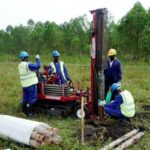
- Boreholes: Drilled using auger, rotary, or percussion methods to reach greater depths, with soil sampling and in-situ testing.
- Standard Penetration Test (SPT): A hammer drives a sampler into the soil, and the number of blows indicates density or consistency.
- Cone Penetration Test (CPT): A cone is pushed into the ground while measuring resistance, providing continuous profiles.
- Dynamic probing and plate load tests: Provide additional information on strength and stiffness.
- Groundwater observations: Standpipes or piezometers measure water levels.
4. Laboratory testing. Samples are tested to classify soils and measure properties:
- Moisture content, Atterberg limits (liquid and plastic limits), and particle size distribution.
- Shear strength (direct shear or triaxial tests).
- Consolidation tests for settlement estimation.
- Compaction tests (Proctor) and California Bearing Ratio (CBR) for roads and fill.
- Swell and free-swell tests for expansive soils.
- Chemical tests such as sulphate and chloride content, which affect concrete durability.
5. Analysis and reporting. Engineers and geologists interpret the data to define soil layers, determine allowable bearing pressure, estimate settlement, and recommend foundation types.
Typical Foundation Recommendations
Depending on results, recommendations may include:
- Shallow foundations: Strip footings or pad foundations where near-surface soils are competent.
- Raft foundations: Spreading loads over a larger area where soils are weak or variable.
- Piled foundations: Transferring loads to deeper, stronger layers where surface soils are poor.
- Ground improvement: Replacing or stabilising weak soils, preloading, or compaction.
- Special measures for expansive soils: Deeper foundations, void formers, moisture control, or soil replacement.
Investigation Depth and Number of Points
Depth and spacing depend on the structure’s size, loading, and ground complexity. A guiding principle is to explore to a depth where additional stress from the structure becomes negligible, or to a competent bearing layer. Larger or more sensitive structures require more investigation points, and variable geology calls for closer spacing.
Consequences of Skipping Investigation
- Foundation failure or excessive settlement.
- Cracking and costly repairs.
- Over-designed foundations that waste money.
- Delays during construction due to unexpected conditions.
- Safety risks and liability exposure.
The cost of investigation is typically small relative to total construction cost, and often saves far more than it costs.
Choosing a Provider
Look for a team with geotechnical engineering and geology expertise, access to appropriate drilling and testing equipment, and a laboratory that follows recognised standards. The report should be clear, with logs, test results, interpretation, and practical recommendations.
Conclusion
A geotechnical investigation turns uncertainty about the ground into engineering knowledge. In Kenya’s variable conditions, it is the foundation of safe, durable, and economical construction.
Innercore Geoconsultants Services Limited carries out geotechnical investigations, soil testing, and reporting for buildings, roads, water towers, and other infrastructure. Contact us before you break ground.