Skip to content

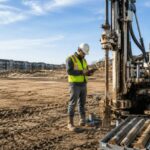
Nairobi’s skyline keeps rising. Towers in Upper Hill, Westlands, Kilimani, the CBD, Mombasa Road, and Thika Road corridors have changed the face of the city. Tall buildings are marvels of structural engineering, but they stand on ground that has its own history and character. The discipline that reads that history and translates it into design decisions is engineering geology.
This article explains how Nairobi’s geology influences high-rise buildings, what investigations are needed, and which foundation approaches are commonly considered.
What Engineering Geology Does
Engineering geology applies geological knowledge to engineering projects. For a high-rise building, it describes the rock and soil types, their structure and weathering, groundwater conditions, geological hazards such as faults and unstable ground, and how these affect excavation, foundations, and long-term performance. It works hand in hand with geotechnical engineering: the geologist explains what the ground is and why, while the geotechnical engineer quantifies how it behaves under load.
A Brief Geological Picture of Nairobi
Nairobi lies on the eastern shoulder of the Kenya Rift region, within a landscape shaped by volcanic activity over millions of years. Much of the city is underlain by volcanic rocks and pyroclastic deposits, including trachytes, phonolites, tuffs, and agglomerates, with lake and river sediments in places. Different lava flows and ash deposits are layered, and each unit has distinct properties. Between lava flows, weathered zones and soil horizons (palaeosols) can form weaker layers.
The western and central parts of the city tend to be underlain by relatively strong volcanic rocks at shallower depth, whereas the eastern areas, towards Embakasi, Athi River, and the plains, include thick tuffs, lake sediments, and expansive black cotton soils. These variations mean a tower in Upper Hill may face very different ground from one on the Eastlands side.
Why High-Rise Buildings Raise the Stakes
Tall buildings impose very high loads on small footprints, create large overturning moments from wind and earthquakes, and are sensitive to differential settlement. A small tilt at the base translates into large displacement at the top. They also often include deep basements for parking and services, which means deep excavations near neighbouring buildings and roads, with groundwater and ground movement concerns.
For these reasons, the investigation for a high-rise needs to be deeper, more detailed, and more rigorous than for low-rise buildings.
Key Geological Issues in Nairobi
Variable weathering. Volcanic rocks may be fresh and strong at one depth and highly weathered or altered at another, with abrupt changes over short distances. Weathered tuffs can behave like stiff soils, while fresh trachyte behaves as strong rock. Mapping this transition is vital for foundation level selection.
Soft or weak interbeds. Layers of ash, paleosol, or clay between lava flows can be weak and compressible, creating potential for differential settlement or sliding on slopes.
Black cotton and expansive soils. In parts of the city, surface layers of expansive clay overlie the volcanic sequence. While deep foundations often bypass them, basement walls, slabs, and nearby ground can still be affected by moisture changes.
Groundwater. Perched water tables, seasonal fluctuations, and springs affect basement excavations, dewatering, uplift pressures, and waterproofing. Water also lowers the strength of weathered materials and can induce erosion.
Faults and fractures. The Rift region contains faults and fracture systems that can affect rock quality, groundwater flow, and local stability. Fault zones may be weak or fractured and require specific investigation.
Cavities and variable fill. Old quarries, backfilled excavations, and uncontrolled fill exist in parts of the city, introducing unpredictability.
Seismic Considerations
Nairobi is not at the centre of the most active seismic belts, but Kenya sits in an active rift system, and earthquakes of moderate magnitude can occur in the region. For tall buildings, seismic design and site response matter. Soft soils may amplify ground motion, while stiff rock tends to reduce it. A site classification based on shear wave velocity or standard penetration data helps determine design ground motion parameters. Where saturated loose sands or silts exist, liquefaction potential should be assessed. Designers should follow applicable codes and take the advice of structural and geotechnical specialists.
Investigation Requirements for High-Rise Buildings
A competent investigation for a high-rise typically includes:
- Desk study and geological mapping of the site and its surroundings.
- Deep boreholes extending well below the proposed founding level, often into competent rock, with continuous sampling or coring in rock.
- SPT and other in-situ tests in soil and weathered rock.
- Rock testing such as uniaxial compressive strength and point load tests, with rock quality designation (RQD) and fracture logging.
- Geophysical surveys where useful, for example seismic or resistivity methods to detect variations, faults, or cavities.
- Groundwater monitoring with piezometers over time to capture seasonal changes.
- Laboratory testing for strength, compressibility, durability, and chemical aggressiveness of soil and groundwater.
- Settlement and deep excavation analyses supported by numerical modelling where needed.
The number and spacing of boreholes should reflect the building footprint and the variability of the ground, with extra points where conditions change.
Foundation Options for Tall Buildings
Foundation choice follows the geology. Raft foundations spread loads across a large thick slab, suitable where reasonably competent ground exists at shallow depth. Piled foundations transfer loads through weak layers into stronger rock or dense soil, using bored piles, with socketing into rock for end-bearing and shaft friction. Piled rafts combine a raft with piles to share the load efficiently and control settlement. Deep basements reduce net pressure on the ground, since excavated soil weight offsets part of the building load, but demand careful groundwater and retention design.
Where rock is shallow and strong, direct bearing on rock may be economical. Where weak or variable layers exist, piles or ground improvement may be needed.
Deep Excavation and Neighbouring Structures
Basements in a dense urban area such as Nairobi raise questions about excavation support (diaphragm walls, secant piles, soldier piles with lagging, or soil nailing), groundwater control, and movement of adjacent buildings and services. Engineering geology informs the stability of excavation faces and the behaviour of weathered rock or tuff when cut. Monitoring of settlement and vibration around the site, and condition surveys of adjacent buildings before work starts, are good practice.
Construction Risks and Quality Control
Typical risks include encountering unexpected boulders, cavities, or soft layers during piling, groundwater inflows into excavations, and variations in rock level across the footprint. Pile testing, including integrity tests and load tests, verifies performance. Geotechnical supervision during excavation and piling ensures that actual conditions are compared with the design assumptions and that changes are handled early.
Regulation and Professional Practice
High-rise projects in Nairobi require approvals from the county planning authority, involvement of registered engineers, and compliance with building codes and standards. Engaging an experienced geotechnical engineer and an engineering geologist from the early design stage, ideally during site selection, helps avoid costly redesign and manage risk.
Frequently Asked Questions
Is Nairobi ground generally good for tall buildings? Many areas have competent volcanic rock at manageable depth, but variability, weathering, groundwater, and local black cotton soils mean each site needs investigation.
Do all high-rise buildings need piles? No, but many do. The choice depends on ground conditions and loads.
Why is groundwater monitoring needed? Because levels change seasonally and affect basement design and excavation.
Basement Waterproofing and Groundwater Management
Basements in Nairobi must contend with groundwater that may rise during rainy seasons. Design options include waterproofing membranes, watertight concrete, drainage systems beneath slabs, and sump pumps. The geotechnical investigation provides groundwater levels, permeability, and expected seasonal range so the designer can choose between a fully tanked (watertight) basement and a drained system. Dewatering during construction must be planned to avoid destabilising neighbouring properties or drawing down water levels excessively. In weathered tuffs, uncontrolled water flow can erode fine particles and cause settlement of nearby ground, so control measures matter.
Case Illustration: A 30-Storey Tower Concept
Picture a 30-storey tower planned in a busy part of Nairobi. The investigation includes deep boreholes to 40 metres, with SPT in the upper soils and rock coring below. The logs reveal 6 metres of stiff clay and weathered tuff, followed by interbedded tuff and weathered trachyte, with fresh trachyte below 28 metres. Groundwater is encountered at 7 metres, and a weak, clayey layer is found between lava flows at about 20 metres.
The design team may then evaluate a piled raft, with bored piles socketed into the stronger rock, designed to bypass the weak interbed. Basement excavation would be supported by secant piles, with dewatering and monitoring of neighbouring structures. This type of integrated solution is only possible when geological understanding underpins the design.
Key Takeaways
In essence, high-rise development in Nairobi demands respect for the geology beneath it. The city’s volcanic sequence, variable weathering, groundwater, and regional tectonic setting influence every decision from foundation type to basement construction. Projects that begin with thorough investigation, integrate engineering geology into design, and monitor conditions during construction are best placed to deliver safe towers on time and within budget.
Conclusion
Nairobi’s volcanic and sedimentary geology offers both opportunities and challenges for high-rise buildings. Engineering geology brings clarity: it explains the layers, weathering, structure, water, and hazards that shape foundation and basement design. A thorough investigation, informed interpretation, and careful construction supervision allow towers to rise safely on ground that has been properly understood.