Skip to content

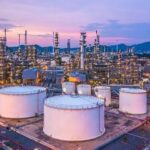
A 700,000-barrel-a-day refinery is being built on a coast whose rocks, mangroves and communities were never the hard part. The hard part is the crude in the ground 800 kilometres inland.
Status as of 30 September 2026. The groundbreaking was scheduled for today; this article does not report its outcome.
Where things stand
President William Ruto and Aliko Dangote were due to break ground today on the Dangote East Africa Refinery at Lamu Port, a 700,000 barrel-per-day refinery and petrochemical complex on LAPSSET land. Cost estimates range from about US$16 billion (Dangote’s figure) to US$17 billion (Kenyan authorities), with completion targeted between roughly 2029 and 2030. Engineers India Ltd won a contract worth more than US$450 million to manage engineering and construction, and 2,930 tonnes of equipment landed at Lamu Port on 26 September.
| Capacity | 700,000 bpd (about 34.8 million tonnes a year), single train |
| Cost | US$16–17 billion quoted; up to US$20 billion cited elsewhere |
| Build time | 30 months to four years from groundbreaking |
| Intended markets | Kenya, Uganda, South Sudan, Rwanda, Burundi, DR Congo, Ethiopia |
| Promised jobs | About 60,000 (Kenyan government and Dangote claims) |
Two basins, one project
Geologically, the refinery touches two very different sedimentary systems. Its feedstock is meant to come from the South Lokichar Basin in Turkana, a Cenozoic rift basin on the eastern branch of the East African Rift. Its site sits on the edge of the Lamu Basin, a passive-margin basin on the Indian Ocean coast.
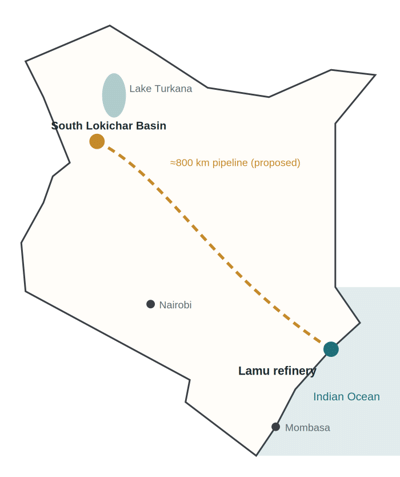
Figure 1. Schematic location map (not to scale; positions approximate). The pipeline line is indicative, not a surveyed route.
The crude: rich source rock, awkward oil
Kenya’s oil comes from a lake. During the Miocene, the South Lokichar half-graben held a deep rift lake in which the Lokone Shale accumulated. Operator data put its average organic content near 3.5% and classify it as a highly oil-prone, Type I lacustrine source rock. It charged fluvial and gravity-flow sandstones of the Lower Auwerwer and Lokone formations, sealed by lacustrine mudstones and capped by the Auwerwer Basalts. Discoveries cluster against the basin-bounding Lokichar fault, a classic footwall-derived rift play.
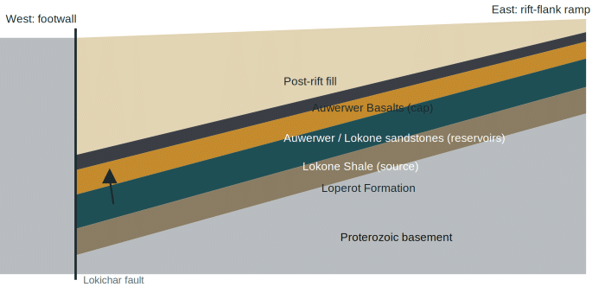
Figure 2. Highly schematic half-graben section. Layer thicknesses are exaggerated toward the bounding fault; the arrow shows oil migrating from the Lokone Shale into reservoirs against the fault.
The problem is the oil itself. South Lokichar crudes are low in sulphur and gas but highly waxy, with a bimodal n-alkane distribution rich in heavy paraffins. Early appraisal quoted a gravity of about 29° API. Waxy oil can gel at ambient temperature, which is why earlier pipeline concepts assumed heated, insulated lines over the whole distance. A refinery designed around this crude has to plan for pour-point management from the wellhead to the crude tanks.
The setbacks
Feedstock. This is the central geological and commercial risk. South Lokichar holds roughly 560 million barrels of recoverable oil. At full throttle, 700,000 barrels a day would consume that entire resource in about 800 days, a little over two years. The first development phase targets only 20,000 barrels a day, with first oil aimed at December 2026, so early Lokichar output would supply under 3% of nameplate capacity. Analysts note Uganda’s crude is already committed to the East African Crude Oil Pipeline through Tanzania, and South Sudan’s exports mostly flow through Sudan. One analysis says the plant would initially rely on imported crude landed at Lamu.
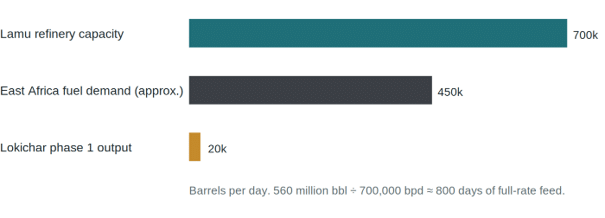
Figure 3. Scale of the feedstock gap. Demand figure is a press estimate; phase-1 output is the operator’s stated target.
Land and rights. On 28 September, 133 Chandavai residents asked the Malindi Environment and Land Court to halt activity on LR No. 13061 in the Hindi/Manda Magogoni area, citing ancestral claims, farms, mosques and graves. The court declined to block the groundbreaking but ordered the status quo kept until a hearing on 14 October. Residents also allege preparatory soil testing began in July without proper environmental procedure.
Ecology and precedent. Lamu’s mangroves account for a large share of Kenya’s mangrove cover; an African Development Bank assessment for the earlier Lamu coal proposal put it at about 75%. Greenpeace Africa has demanded an independent, published ESIA before further approvals. The LAPSSET port itself was previously found by a Kenyan court to have breached public-participation requirements, with compensation ordered for roughly 4,600 fishers.
Money and markets. Estimates span US$16–20 billion while Dangote also funds the expansion of his Lagos plant. Kenya’s own demand is far below 700,000 bpd, so the plant depends on export markets and pipelines that do not yet exist.
The potential benefits
Kenya imports nearly all its refined fuel, so domestic refining could cut foreign-exchange exposure and price shocks. A deep-water port linked to the LAPSSET corridor gives landlocked neighbours an alternative gateway. Petrochemical clusters, storage and shipping services, and engineering work could follow. Kenyan officials cite about 60,000 jobs, though that figure is a projection and its mix of construction versus permanent roles has not been independently verified. For geoscientists, a domestic refinery also creates demand for reservoir characterisation, coastal geotechnics and environmental monitoring skills.
What a geologist would watch
The Lamu coast is underlain by a sedimentary wedge about 3 km thick onshore and around 10 km near the coast, mostly Quaternary alluvium and late Tertiary rocks over older Karoo and Mesozoic strata. Sound siting needs shallow-borehole data on soft mangrove clays, dune sands and reef limestone for tank-farm settlement, plus groundwater and saltwater-intrusion mapping, sea-level and storm-surge modelling for a shoreline facility, and dredging and spill-trajectory studies for Manda Bay. Offshore, Mbawa-1 (2012) found gas and Sunbird-1 (2014) found Miocene reef oil, so the Lamu Basin itself remains under-explored, though nothing there is yet to be any feedstock.
Future outlook
The next twelve months are informative. Gulf Energy plans to spud its first development well around 1 November 2026, with first oil in December and initial exports through Mombasa projected for early 2027. The 14 October court hearing and the ESIA process will show whether local consent can be secured. Construction is expected to run to about 2029–2030, and Kenya has to solve the crude question before then: a heated Lokichar–Lamu line, regional crude agreements, or long-term imports. Global demand transition adds risk to a plant with a multi-decade payback. The refinery will succeed or fail on the rocks in Turkana far more than on the sand at Lamu.