Skip to content
Lithium demand has surged alongside the growth of battery manufacturing and electric vehicle adoption, pulling a wave of new exploration investment into a commodity that, until recently, sat at the margins of mainstream mineral exploration. But lithium doesn’t behave like a typical exploration target. It occurs in fundamentally different geological settings — hard rock pegmatites, continental brines, and sedimentary clay deposits — each requiring a distinctly different exploration toolkit.
This guide walks through the major lithium deposit types and the geoscience methods best suited to exploring each one.
Why Lithium Exploration Doesn’t Follow a Single Playbook
Most metals exploration programs follow broadly similar principles — geological mapping, geochemical sampling, geophysical surveys, and drilling, sequenced to progressively de-risk a target. Lithium complicates this picture because its three major deposit types form through entirely different geological processes and require correspondingly different detection methods. A technique that works well for identifying pegmatite lithium may be almost useless for brine exploration, and vice versa.
Hard Rock Lithium (Pegmatites)
Geological setting. Lithium-bearing pegmatites — coarse-grained igneous rocks enriched in lithium, along with associated elements like tantalum, cesium, and beryllium — form from the crystallization of highly evolved granitic magmas. Spodumene, the primary lithium ore mineral in most hard rock deposits, forms within these pegmatite bodies.
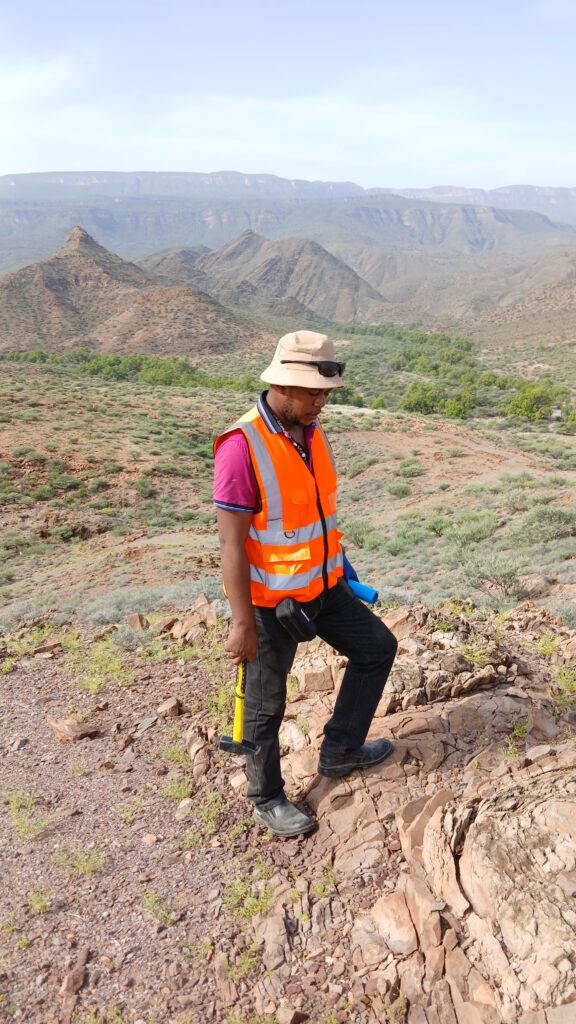
Geological mapping. Because pegmatites are often visible at surface as distinct, coarse-grained intrusive bodies, field mapping remains a foundational tool. Experienced geologists can often identify prospective pegmatites through mineral assemblage, texture, and zonation patterns, though lab confirmation is always needed.
Geochemistry. Soil and rock geochemistry helps directly detect lithium and pathfinder elements — cesium, tantalum, rubidium, boron — that tend to be enriched in fertile pegmatite systems.
Geophysics. Plays a more limited role here. Radiometric surveys can help map pegmatite outcrops, and gravity or magnetics can assist mapping the broader intrusive complex, but these are generally secondary to mapping and geochemistry.
Drilling. With reasonably well-defined surface expression, drilling can proceed with good confidence once mapping and geochemistry identify a prospective body, though internal grade variability requires careful drill spacing.
Continental Brine Deposits
Geological setting. Brine deposits form in closed-basin evaporite environments — salt flats or salars in arid regions — where lithium accumulates in concentrated saline groundwater within porous sediments beneath the salt crust. This is fundamentally a hydrogeological target.
Hydrogeology. The central discipline here. Understanding aquifer porosity, permeability, brine chemistry with depth, and basin structure is essential for resource estimation and sustainable extraction planning.
Geophysics. Plays a much larger role than in hard rock exploration, since the target is entirely subsurface. Transient electromagnetic (TEM) surveys are particularly effective, as brine’s high salinity produces a strong conductivity contrast against surrounding sediments.
Drilling and testing. Typically involves monitoring wells and extended pumping tests to characterize aquifer behavior and sustainable yield — a longer process than resource-definition drilling for hard rock.
Environmental considerations. Because extraction interacts directly with basin water balance, environmental and hydrological assessment plays an outsized role in project development.
Sedimentary Clay Deposits
Geological setting. Lithium-bearing clay deposits form where lithium concentrates within clay minerals in sedimentary basins, often associated with volcanic ash alteration.
Exploration approach. Combines elements of hard rock and sedimentary exploration. Mapping identifies favorable basins and ash horizons, while systematic geochemical drilling and assay confirm lithium concentration — clay-hosted lithium isn’t identifiable visually the way spodumene often is.
Metallurgy. Extraction from clays typically requires different, sometimes less-established processing methods, so metallurgical testwork plays an outsized early role — processing viability is often the bigger source of project uncertainty than the resource itself.
Comparing the Three Approaches
| Deposit Type | Primary Discipline | Key Methods | Main Challenge |
|---|---|---|---|
| Hard rock pegmatite | Geological mapping + geochemistry | Field mapping, soil/rock geochemistry, pathfinders | Internal grade variability |
| Continental brine | Hydrogeology + geophysics | TEM surveys, monitoring wells, pumping tests | Sustainable yield estimation |
| Sedimentary clay | Geochemistry + metallurgy | Systematic drilling/assay, basin mapping | Processing/extraction viability |
Common Mistakes
Applying hard-rock-style drilling to brine projects without hydrogeological characterization; underinvesting in geophysics for brine targets; treating clay-hosted lithium as a purely geochemical target without addressing metallurgical uncertainty.
Building the Right Team
Because lithium’s deposit styles require such different approaches, assembling the right team matters more than for most commodities — few individual specialists cover geology, hydrogeology, geophysics, and metallurgy equally well, making a multidisciplinary geoconsulting partner particularly valuable.
Exploring for lithium and need to align your technical approach with your deposit style? Get in touch to discuss your project.