
A decade ago, “decarbonization” was a term mostly confined to climate policy circles. Today it sits on boardroom agendas, investor scorecards, and national development plans alike. Whether you work in energy, finance, manufacturing, or public policy, the shift away from carbon-intensive fuels is no longer a distant target — it’s actively reshaping how infrastructure gets built, how capital gets allocated, and how entire economies plan their next decade of growth.
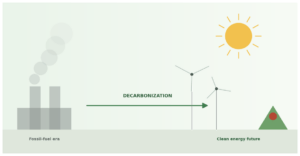
So what does decarbonization actually involve, beyond the headlines? Here’s a practical look at what it means, why it’s accelerating, and where the real opportunities and challenges lie.
What Decarbonization Actually Means
At its core, decarbonization is the process of reducing the carbon dioxide and other greenhouse gases released by human activity — primarily by shifting away from coal, oil, and natural gas toward low- and zero-carbon energy sources, while also using energy more efficiently. It’s broader than “clean electricity.” It touches how buildings are heated, how goods are manufactured and shipped, and how some of the world’s most carbon-intensive industries — steel, cement, chemicals — rethink processes that have barely changed in a century.
Why It’s Accelerating Now
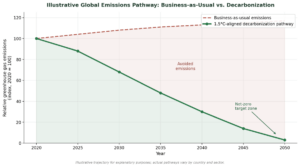
Two forces are driving the pace: climate science and economics. The Paris Agreement’s goal of limiting warming to well below 2°C requires steep, sustained emissions cuts over the coming decades — and that target is increasingly backed by policy teeth, from carbon pricing to border-adjustment mechanisms like the EU’s CBAM, which now applies a carbon cost to certain imported goods based on how they were produced.
At the same time, the economics have flipped. Renewable generation is now cost-competitive with fossil fuels in most markets, and countries reliant on imported fuel increasingly see domestic clean energy as a matter of both cost control and energy security rather than just environmental policy.
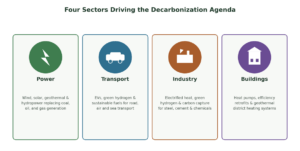
Each of these sectors moves at a different pace. Power generation has the clearest pathway and is furthest along. Heavy industry and long-haul transport remain the hardest to crack, since they require either intense heat, chemical reactions that inherently release CO₂, or energy density that current battery technology can’t yet match — pushing research toward green hydrogen, sustainable fuels, and carbon capture.
The Technology Toolkit
- Renewables — wind, solar, geothermal, and hydropower, now among the cheapest sources of new power in most markets
- Storage — grid-scale batteries and emerging long-duration technologies that solve renewable intermittency
- Green hydrogen — produced via electrolysis, offering a path to decarbonize heavy industry and transport that’s hard to electrify directly
- Carbon capture, utilization, and storage (CCUS) — capturing emissions at the source for processes that can’t yet go fully clean
- Electrification — replacing fossil-based processes in vehicles, heating, and industry with electric alternatives
A Real-World Proof Point: Kenya
Kenya is one of the clearest demonstrations that decarbonization and energy access growth aren’t mutually exclusive. By developing its geothermal resources along the Great Rift Valley, the country has built one of the highest shares of renewable electricity in the world — geothermal alone now supplies a plurality of the national grid, alongside hydropower and wind. Over the same period, national electricity access has expanded more than two-and-a-half-fold. The lesson: with the right resource base and sustained policy commitment, countries can decarbonize while they grow, not instead of growing.
The Bottom Line
Decarbonization isn’t a single technology or policy — it’s a systemic shift in how energy, industry, and infrastructure are built. The direction is no longer in serious doubt; what’s still being worked out is the pace, the financing, and how fairly the costs and benefits are shared along the way. For businesses and policymakers alike, the organizations paying attention to that transition now — rather than reacting to it later — are the ones best positioned for what comes next.
What does decarbonization look like in your sector? I’d welcome the conversation in the comments.