Skip to content

Kenya has quietly become one of the world’s most compelling geothermal success stories. While countries with far larger economies have struggled to move geothermal projects from paper to production, Kenya now generates a substantial share of its national electricity from steam pulled directly out of the Rift Valley floor. Understanding how this happened, and where the country’s geothermal ambitions are headed next, offers a useful window into what’s possible when geological potential meets sustained investment and technical expertise.
Why the Rift Valley Is Geothermally Rich
Kenya sits directly on the East African Rift, a massive tectonic feature where the African continent is slowly splitting into two separate plates. This ongoing tectonic activity brings the Earth’s mantle heat unusually close to the surface, creating a chain of volcanic centers running the length of the Rift Valley. These volcanic systems, many of them still geologically active, sit atop hydrothermal reservoirs capable of producing the high-temperature steam needed for commercial power generation.
This geological setting gives Kenya an estimated geothermal potential of several thousand megawatts, concentrated along a series of prospects stretching from Lake Turkana in the north down through the central Rift Valley. Only a fraction of that potential has been developed so far, which is precisely what makes the sector’s future so significant.
Olkaria: The Heart of Kenyan Geothermal Development
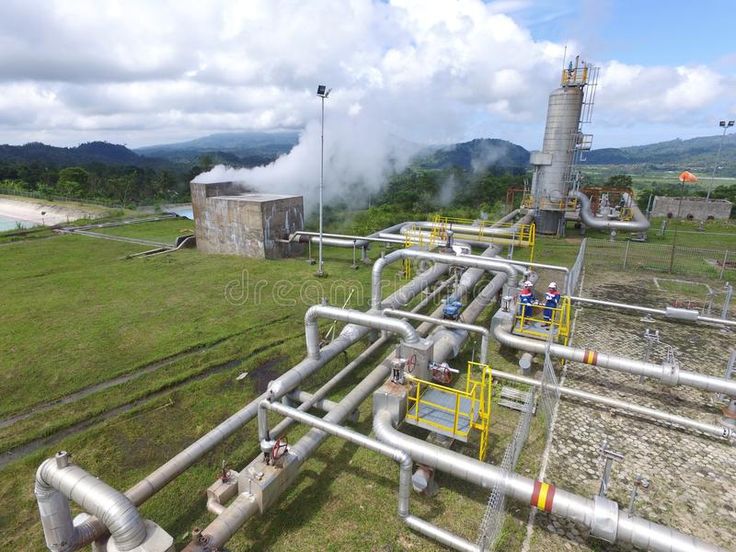
The Olkaria geothermal field, located within Hell’s Gate National Park near Naivasha, is where Kenya’s geothermal story really begins. Development at Olkaria started in the 1980s and has expanded steadily ever since, growing into one of the largest geothermal complexes in Africa. Today, Olkaria consists of multiple power plants operated primarily by KenGen, Kenya’s state-owned power generation company, alongside independent power producers that have entered the field more recently.
What makes Olkaria particularly notable is the diversity of technology deployed across the field. It includes single-flash, double-flash, and binary cycle plants, reflecting decades of technical evolution as operators have learned to extract maximum value from reservoirs with varying temperature and pressure characteristics. The field has also become something of a proving ground for geothermal expertise in the region, with Kenyan engineers, geologists, and technicians developing deep institutional knowledge that has since been exported to geothermal projects elsewhere on the continent.
Olkaria’s success has not been without challenges. Reservoir pressure decline in some sectors of the field has required careful reservoir management, including strategic reinjection of spent geothermal fluid to help sustain long-term productivity. These ongoing management efforts underscore an important truth about geothermal energy: unlike a solar panel that simply requires periodic cleaning, a geothermal field is a living system that requires continuous monitoring and adaptive management over its operational lifetime.
Menengai: The Next Chapter
North of Olkaria lies the Menengai geothermal prospect, centered on a large volcanic caldera near Nakuru. Menengai represents a somewhat different development model than Olkaria. Rather than a single vertically integrated operator handling exploration, drilling, and power generation, Menengai has been developed under a model where the Geothermal Development Company (GDC) handles the upstream exploration and drilling work, with steam then sold to independent power producers who build and operate the actual power plants.
This model was designed to de-risk geothermal investment for private developers by shifting the highest-risk phase of the project, exploratory drilling, onto a government-backed entity better positioned to absorb that risk. It’s a structure that has attracted attention from other geothermal-rich countries looking for ways to accelerate private sector participation without requiring investors to shoulder the full exploration risk themselves.
Menengai has faced its own set of technical and financial challenges, including delays in well testing and financing negotiations for the associated power plants, illustrating that even well-designed development models still depend on careful execution and sustained institutional support to succeed.
Beyond Olkaria and Menengai: Emerging Prospects
Kenya’s geothermal ambitions extend well beyond its two flagship fields. The Baringo-Silali geothermal block, further north in the Rift Valley, represents one of the country’s largest untapped geothermal resources, encompassing multiple volcanic centers with significant estimated capacity. Development here is at an earlier stage, with ongoing exploration work aimed at better characterizing the resource before major drilling investment proceeds.
Other prospects, including Suswa, Longonot, and Eburru, add further to Kenya’s geothermal pipeline, each at different stages of exploration and development. Collectively, these prospects suggest that Kenya’s geothermal story is far from finished, with decades of potential development still ahead if exploration and financing continue at pace.
Geothermal’s Role in Kenya’s Energy Mix
Geothermal energy has become a cornerstone of Kenya’s electricity generation, providing a level of baseload reliability that complements the country’s substantial hydropower capacity, which remains vulnerable to increasingly unpredictable rainfall patterns linked to regional climate variability. As droughts have periodically strained hydropower output in recent years, geothermal’s consistent, weather-independent generation has proven to be an increasingly valuable stabilizing force in the national grid.
This reliability has also made geothermal central to Kenya’s broader decarbonization strategy. With one of the cleanest electricity grids in Africa already, largely thanks to its geothermal and hydropower capacity, Kenya has positioned itself as a potential hub for green industrialization, including data centers and manufacturing operations seeking low-carbon power sources.
Lessons for Regional Geothermal Development
Kenya’s experience offers valuable lessons for neighboring countries within the East African Rift system, including Ethiopia, Djibouti, and Tanzania, all of which possess significant geothermal potential of their own. Chief among these lessons is the importance of sustained, patient investment in exploration and drilling, phases that carry substantial financial risk but are ultimately what determines whether a promising geological setting translates into reliable, commercial power generation.
Kenya’s development of local technical capacity has been equally important. Decades of hands-on experience at Olkaria have built a deep bench of Kenyan geoscientists, drilling engineers, and reservoir specialists, expertise that reduces long-term dependence on foreign consultants and strengthens the country’s ability to manage its geothermal assets independently over time.
Looking Ahead
Kenya’s geothermal sector still has significant room to grow. With thousands of megawatts of estimated potential still undeveloped across the Rift Valley, the country’s geothermal story is really still in its middle chapters. As financing structures mature, exploration techniques improve, and regional collaboration expands, the Rift Valley’s underground heat is likely to remain one of Kenya’s most valuable, and most distinctly homegrown, energy assets for decades to come.